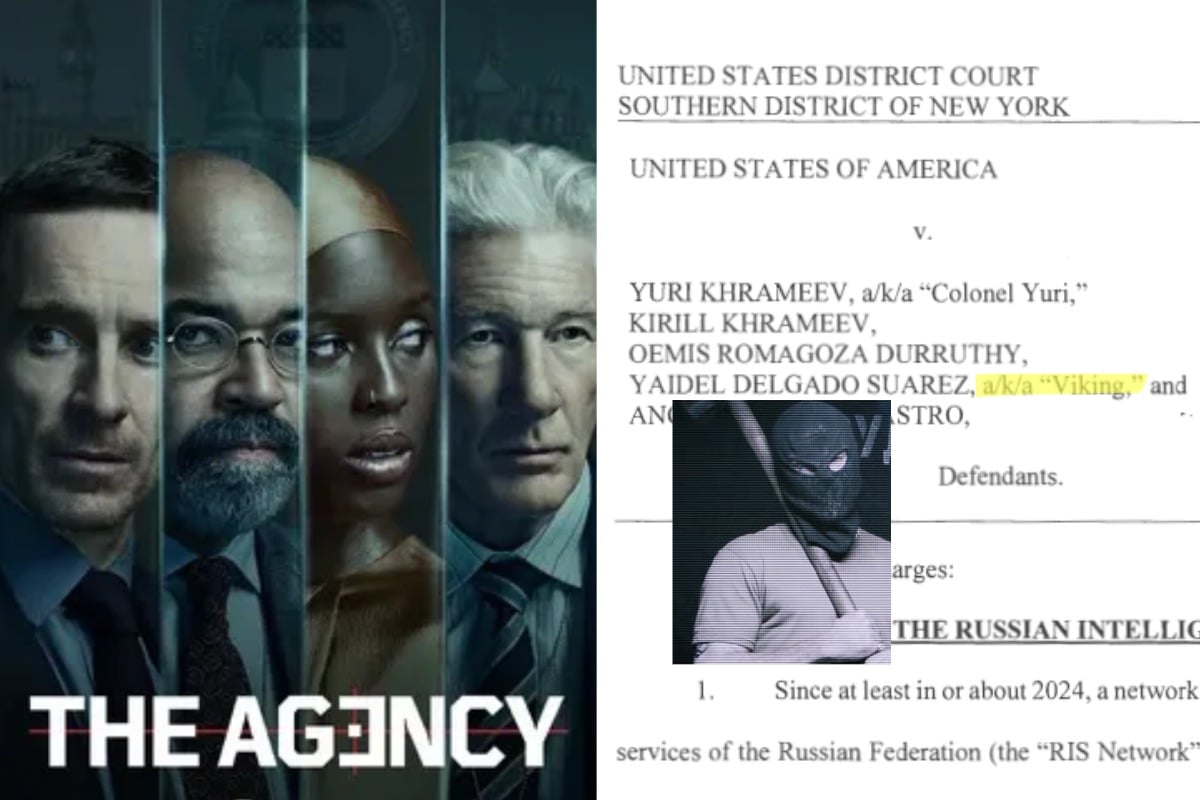
Buried in a 17-page federal indictment recently unsealed in New York is an alleged Russian murder plot that could have come straight out of a spy thriller. There are encrypted messages, photographs of a target’s home, a $40,000 offer to make him disappear—and a recruiter called “Viking.”
Viewers of Paramount+’s The Agency may recognize the name. In the series’ second season, “Viking” is a former U.S. Marine working for a Russian-backed mercenary group—a ruthless operative known for carrying out executions with a sledgehammer.
The “Viking” named in the federal case is Yaidel Delgado Suarez, a Cuban national living in Russia. Prosecutors allege he recruited people inside the United States to help track down and kill a prominent Russian dissident believed to be living near Washington, D.C.
The indictment draws no connection to the show. But the alleged conversations describe how a paid photography assignment became an effort to find someone willing to commit murder.
According to the indictment unsealed Sept. 15 in Manhattan federal court, the approach began July 29 with a message to a Venezuelan citizen living in Brooklyn.
“Do you have someone in Washington you trust?” asked Angel Eduardo Castro, a Venezuelan national living in Russia.
Castro explained that his contacts paid people to take pictures of locations. He then forwarded messages from Suarez outlining the work.
The assignment came with specific requirements: photographs and videos of an address, footage from different angles and a hand gesture visible in the recording. The promised payment was between $1,000 and $1,500.
Another message made clear what the photographs were for.
They wanted to “eliminate” or “disappear” the person associated with the address, according to the messages quoted in the indictment. Whoever carried out the job would receive $40,000.
Prosecutors say the intended victim was a prominent critic of the Russian government.
The Brooklyn resident said he would take pictures but would not personally carry out the killing. That answer did not end the conversation.
Over the following weeks, the alleged recruiters continued discussing surveillance and who might finish the job. They used construction language as cover: Measuring land meant surveillance. “Construction” meant murder.
The resident initially resisted speaking directly with Suarez.
“Can we talk through you so it gets disguised?” he asked Castro, according to the indictment. “You know they track everything here.”
Suarez contacted him directly anyway.
On Aug. 26, he allegedly supplied two addresses publicly associated with the dissident and pressed for the surveillance to happen that day or the next. Prosecutors trace the location information to another defendant, Yuri Khrameev, a former Russian intelligence colonel.
Suarez told the resident to delete the chat containing photographs and coordinates, keep his distance and put his phone in airplane mode while recording, according to the indictment.
The resident subsequently photographed and filmed the properties, sending at least some of the material back to Suarez.
With the surveillance in hand, the conversation returned to the killing.
Suarez allegedly asked whether the resident knew someone willing to do “construction”—or whether he would be interested in doing it himself.
The resident said he would look for the “right people.” Later, he said he had someone in mind but needed to ask whether that person would agree.
Suarez was allegedly under pressure to produce an answer.
“I have a chain and my boss has questions,” he wrote. He said he also had people in Mexico who could carry out the killing, but they were delayed.
The indictment alleges Suarez and at least one other person approached additional people inside the United States, offering substantial payments to surveil and murder the dissident and other potential targets.
The documents also suggest the network had been gathering information about the intended victim long before the Brooklyn resident received his assignment.
Another defendant, Oemis Romagoza Durruthy, allegedly had photographs and videos showing the inside of a dwelling associated with the dissident.
Some files indicated they had been taken or saved in November 2025—months before the summer surveillance operation. At least one photograph appeared to be the same image later passed through the alleged recruitment chain.
The indictment does not explain how those interior images were obtained. It does not publicly identify the intended victim or say whether the Brooklyn resident was cooperating with investigators.
Federal authorities announced charges against five men: Suarez, Castro, Durruthy, Yuri Khrameev and Khrameev’s son, Kirill, whom prosecutors identify as an officer in Russia’s Federal Security Service.
All five face a charge of conspiracy to finance terrorism. Suarez, Castro and Yuri Khrameev also face a murder-for-hire conspiracy charge.
Authorities said all five remained at large when the charges were announced.
The FBI said it disrupted the operation. The defendants are presumed innocent unless proven guilty.
© 2026 The Salty Soldier. All rights reserved.