In the late 1980s, allegations of ritualistic child abuse at a military daycare center inside the Presidio of San Francisco exploded into one of the most infamous abuse scandals of the era — drawing in military investigators, child psychologists, federal agencies, and national media attention.
The allegations emerged during a period that later became widely referred to as the “Satanic Panic,” a term used to describe a wave of highly publicized abuse investigations, occult allegations, and daycare cases that spread across the United States during the 1980s and early 1990s.
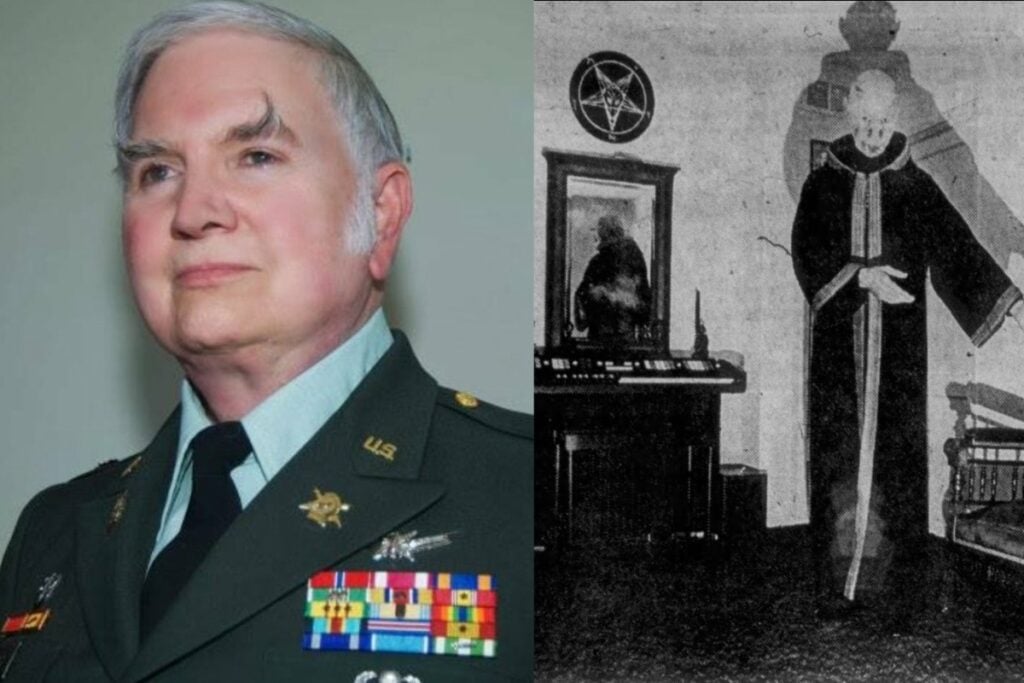
At the center of the controversy was Lt. Col. Michael Aquino: a U.S. Army psychological operations officer, occult author, founder of the Temple of Set, and one of the most controversial military figures of the Cold War era.
Now, nearly four decades later, newly obtained Army records confirm Aquino underwent administrative separation processing from the Army’s Active Guard Reserve program in 1990, while the San Francisco Police Department has formally stated it found “no responsive documents” related to investigative records sought by The Salty Soldier concerning the Presidio Child Development Center allegations.
The response is notable because widespread reporting during the late 1980s repeatedly described San Francisco police as participating in or connected to investigations surrounding the Presidio allegations alongside military authorities, child welfare officials, the FBI, and Army CID.
The conflicting records responses raise new questions about what became of investigative files connected to one of the most widely publicized and controversial abuse investigations of the era, and whether records once described publicly in news coverage were later transferred, destroyed, retained by federal agencies, or remain unreleased decades later.
The Presidio Child Development Center Allegations
The Presidio of San Francisco — now part of the Golden Gate National Recreation Area — was, during the 1980s, an active U.S. Army installation overlooking the Golden Gate Bridge.
Inside the base operated the Presidio Child Development Center, a daycare facility serving military families stationed in the area.
In 1986 and 1987, allegations began surfacing that children attending the facility had been subjected to sexual abuse and ritualistic acts.
The claims emerged during a period of intense national concern surrounding child abuse investigations, occult allegations, and daycare scandals — a period later labeled by media and commentators as the “Satanic Panic.”
Public reporting from the era described military investigators, social workers, therapists, and civilian law enforcement agencies examining claims involving dozens of children connected to the Presidio facility.
Contemporary reporting from outlets including The New York Times, UPI, and the Los Angeles Times described a massive investigative response surrounding the allegations.
According to reporting at the time, a federal grand jury spent roughly 10 months examining allegations tied to the Presidio Child Development Center, while nearly 100 children were reportedly evaluated for physical or psychological signs of abuse.
Public reports also stated that at least some children connected to the investigation were diagnosed with chlamydia, a sexually transmitted disease, though the broader allegations became increasingly controversial as criminal cases began collapsing in court.
In February 1988, a federal judge dismissed the final remaining molestation charge against former daycare worker Gary Hambright after prosecutors encountered evidentiary problems and witness complications.
Hambright, a former Southern Baptist minister and civilian daycare employee, repeatedly denied wrongdoing.
As allegations intensified, the Army announced in 1987 that the Presidio Child Development Center would be closed and demolished. Public statements at the time described the closure as related to “health, safety and sanitation reasons,” although some lawmakers and parents publicly linked the decision to the abuse allegations and declining attendance at the facility.
Ultimately, no criminal conviction tied Aquino to the allegations. However, his name became permanently linked to the case due to both his military role and his public association with Satanism and occult religion.
Who Was Michael Aquino?
Aquino was not an obscure fringe figure.
He was a career Army officer specializing in psychological operations and military intelligence who served during the Vietnam era and later became involved in strategic PSYOP development within the Army Reserve.
Historical accounts indicate Aquino joined the Church of Satan in 1969 while serving in the military. He later split from Church of Satan founder Anton LaVey and founded the Temple of Set in 1975, an occult religious organization centered around the Egyptian deity Set.
At the same time, Aquino maintained a highly unusual dual public identity:
- Army PSYOP officer by profession
- Public Satanist and occult author outside military service
That combination would later fuel enormous public scrutiny once allegations connected to the Presidio daycare became public.
Aquino and “MindWar”
In 1980, while assigned to the 7th Psychological Operations Group at the Presidio of San Francisco, Aquino co-authored a controversial paper alongside Col. Paul Vallely titled From PSYOP to MindWar: The Psychology of Victory.
The paper argued that future warfare would increasingly rely on controlling perception, narrative, morale, and public psychology before conventional military force was used.
One section described “MindWar” as:
“the deliberate, aggressive convincing of all participants in a war that we will win that war.”
The paper was not official Army doctrine, but over time it became heavily cited in conspiracy literature due to Aquino’s occult affiliations and the later Presidio allegations.
Despite frequent online claims, the document itself contains no admissions of criminal conduct or ritual abuse activity. Rather, it reflects Cold War-era strategic discussions about information warfare and psychological operations.
The Records Requests and What They Revealed
In early 2026, The Salty Soldier began filing records requests with both the U.S. Army and the San Francisco Police Department in an effort to better understand two lingering questions surrounding the Presidio case:
What became of Michael Aquino’s military career after the allegations became public, and what records still exist documenting the investigations that dominated headlines during the late 1980s?
Requests submitted to the Army sought records related to Aquino’s continued service in the Active Guard Reserve program, including any administrative reviews, retention actions, or separation-related proceedings tied to the period following the Presidio allegations.
The Army ultimately acknowledged responsive records existed and released limited documentation confirming Aquino remained an Active Guard Reserve lieutenant colonel until 1990, when he underwent formal separation processing from active duty.
What remained visible in the released records still revealed significant details about Aquino’s military career. The DD-214 confirmed he held the rank of lieutenant colonel, served in the U.S. Army Reserve Active Guard Reserve program, and remained on active duty until August 31, 1990.
The records also reflected extensive military education and national security-related coursework completed during Aquino’s career, including the Strategic Intelligence Course and the National Security Management Course.
One additional course entry on the DD-214 was fully redacted under the Army’s cited privacy exemption.
The selective redaction stood out because the Army simultaneously released numerous other professional military education entries, awards, assignments, and service-related details throughout the same records.
The Salty Soldier is currently preparing an administrative appeal challenging the redaction of the fully withheld course entry.
The DD-214 further showed Aquino received numerous military decorations during his career, including the Bronze Star Medal, Air Medal, Army Commendation Medal, Meritorious Service Medal, Vietnam Service Medal, and Republic of Vietnam Campaign Medal.
Additional Army orders released alongside the DD-214 stated Aquino was being:
“reassigned as indicated for separation processing”
under Chapter 3 of Army Regulation 635-100, the regulation governing officer separations at the time.
At the same time, substantial portions of Aquino’s separation-related records were withheld or heavily redacted under federal privacy exemptions, including much of the lower separation section of his DD-214.
More significantly, the Army did not state that continuation-board or retention-review records did not exist. Instead, Army officials indicated another office held release authority over portions of those materials, and the matter was referred for further review.
The response from San Francisco police followed a very different path.
Requests submitted under the California Public Records Act sought only high-level records sufficient to determine whether SFPD investigated, coordinated on, or maintained records connected to the Presidio Child Development Center allegations during the 1980s. The request intentionally excluded sensitive material such as child interviews, medical records, witness statements, or identifying information involving minors.
Initially, the department did not say no records existed.
Instead, over a period of months, SFPD repeatedly extended the request, cited backlog issues, referenced the need for records review and redaction, and stated responsive material would need to be examined for potential disclosure under California public records law.
At one point, the department told The Salty Soldier:
“Each document … must be reviewed for exemptions to the CPRA, and those exemptions must be redacted before our release to you.”
That language appeared to indicate records had at least potentially been identified and were undergoing review.
Months later, however, the department abruptly issued a final determination stating:
“The Police Department has determined there are no responsive documents to your request.”
SFPD then advised The Salty Soldier to seek records from the FBI instead.
The absence of responsive records is especially notable given that multiple publicly available court opinions and national news reports from the late 1980s explicitly identified the San Francisco Police Department as participating in investigations connected to the Presidio allegations alongside the FBI and Army CID.
A 1992 federal appellate court opinion involving Aquino stated:
“In November 1986, the San Francisco Police Department (SFPD), the Federal Bureau of Investigation (FBI) and the U.S. Army Criminal Investigation Division Command (CID) began investigating charges…”
The same opinion later noted that:
“the SFPD discontinued its investigation of the Aquinos in September 1988 for lack of sufficient evidence,”
while Army CID continued its inquiry.
Contemporaneous UPI reporting from 1989 also stated that San Francisco police searched the home of Aquino and his wife, Lilith Aquino, after allegations involving satanic ritual abuse surfaced during the investigation.
Despite those publicly documented investigative activities, SFPD has now stated it possesses no responsive investigative records connected to the case.
The result leaves an unusual gap between decades of public reporting describing investigations surrounding the Presidio allegations and the modern-day records responses now being issued by agencies connected to the case.
Why the Case Still Draws Attention
Public interest in historical abuse allegations involving powerful institutions has intensified in recent years following major criminal cases and scandals involving figures such as Jeffrey Epstein, widespread abuse revelations within religious organizations, and sexual abuse investigations involving prominent entertainment industry figures.
Those cases — many involving allegations that were ignored, minimized, or publicly dismissed for years before later gaining broader scrutiny — have renewed interest in controversial investigations from the 1980s and 1990s, including the Presidio allegations and other daycare abuse cases associated with the period later labeled the “Satanic Panic.”
The Presidio allegations remain especially controversial because they sit at the intersection of several subjects that continue to attract public fascination and skepticism alike:
- institutional accountability,
- psychological operations,
- occult symbolism,
- child abuse allegations,
- and the role of law enforcement and government agencies in handling high-profile investigations.
Decades later, many of the core questions surrounding the Presidio case remain unresolved — including what records still exist, where investigative files ultimately ended up, and why agencies today appear unable to produce documentation connected to one of the most widely publicized military daycare scandals of the era.
While the Army has acknowledged records documenting Aquino’s 1990 separation processing still exist, San Francisco police now say they possess no responsive investigative records tied to the Presidio allegations.
© 2026 The Salty Soldier. All rights reserved.