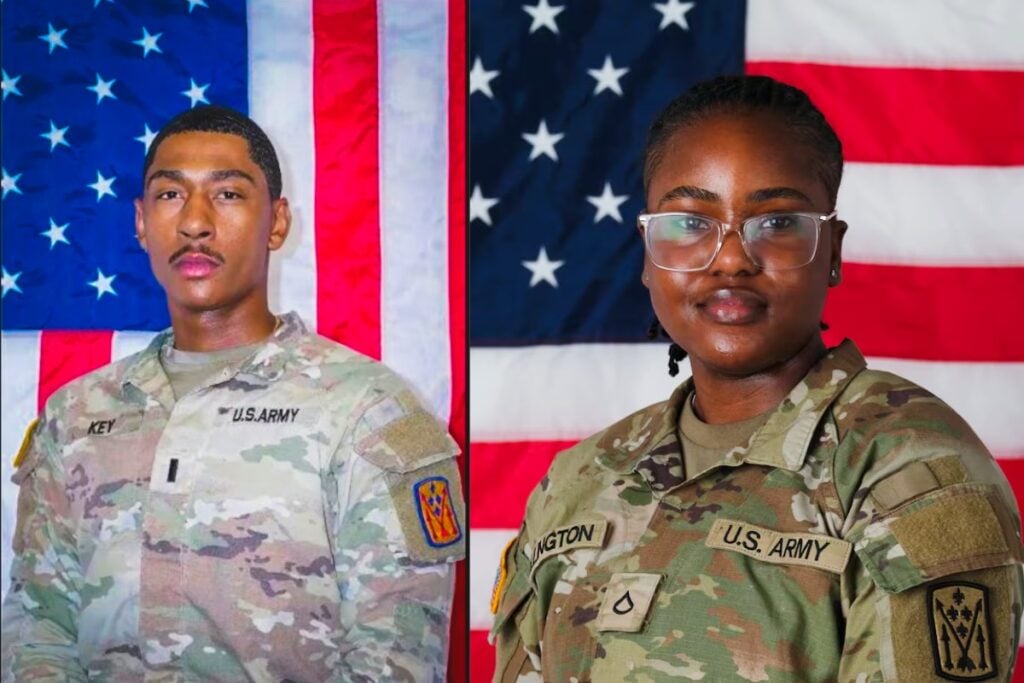
U.S. Army officials have now directly clarified the sequence of events surrounding the deaths of Spc. Mariyah Symone Collington and 1st Lt. Kendrick Lamont Key Jr. in Morocco after days of conflicting media reports and AI-generated summaries created widespread confusion online about what happened off the Atlantic coast near Cap Draa.
In a direct response to The Salty Soldier, U.S. Army Europe and Africa Public Affairs confirmed that Collington initially fell into the Atlantic Ocean during a recreational platoon hike near Cap Draa while service members were off duty from African Lion 2026 activities.
According to MAJ Matthew Blubaugh, Deputy Chief of Media Division for USAREUR-AF Public Affairs, nearby soldiers initially attempted to rescue Collington by forming a human chain using their belts. When that effort failed, Key entered the water in an attempt to save her. A third soldier later entered the ocean in an attempt to assist both soldiers but was able to return safely to shore.
“The rough ocean conditions and strong waves made both the initial rescue and subsequent search efforts extremely difficult,” Blubaugh said in an email to The Salty Soldier.
The clarification comes after multiple national publications published varying descriptions of the incident while AI-generated summaries increasingly presented a definitive version of events that was not always explicitly reflected in the underlying reporting.
Early reports from CBS News described one soldier falling into the water and another entering the ocean in an attempted rescue but did not directly identify by name which soldier occupied each role in the sequence. Other reports introduced additional variations.
A May 3 report from The New York Times stated that one or two members of a human chain may have been swept into the ocean while the original fall victim was reportedly rescued, a version of events that differed from later reporting.
A May 5 Stars and Stripes report acknowledged the inconsistencies directly, writing that “details of the attempt to rescue the pair have trickled out through anonymous sources but appear to conflict.”
Meanwhile, AI-generated summaries online began presenting a definitive narrative stating that Key entered the water to rescue Collington while citing articles that often described unnamed soldiers or conflicting accounts.
In one example reviewed by The Salty Soldier, Google’s AI summary explicitly stated that “Spc. Mariyah Symone Collington fell into the Atlantic Ocean first” and that “1st Lt. Kendrick Key Jr. subsequently entered the water in an attempt to rescue her,” while citing CBS News reporting and official Army press releases as supporting sources. However, neither the cited CBS article nor the Army press releases explicitly identified by name which soldier first entered the water or which soldier attempted the rescue. When asked to identify where the linked reporting directly stated that sequence, the AI system later acknowledged that the article itself did not explicitly assign the named roles within the sequence of events.
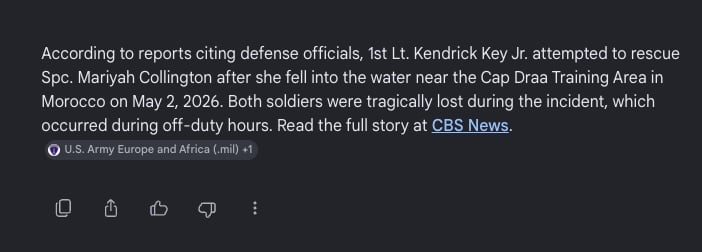
The issue highlighted how AI-generated summaries can convert implied or partially sourced narratives into definitive factual statements, particularly during rapidly developing incidents involving anonymous officials and evolving reporting.
At no point did official Army press releases previously reviewed by The Salty Soldier explicitly identify which soldier first entered the water or which soldier attempted the rescue.
The Army’s clarification now establishes the sequence directly and on the record.
Collington, 19, and Key, 27, were participating in African Lion 2026, U.S. Africa Command’s largest annual multinational military exercise, when the incident occurred May 2 near Morocco’s Atlantic coastline. Both soldiers were later recovered following an extensive multinational search effort involving U.S. and Moroccan forces.
© 2026 The Salty Soldier. All rights reserved.