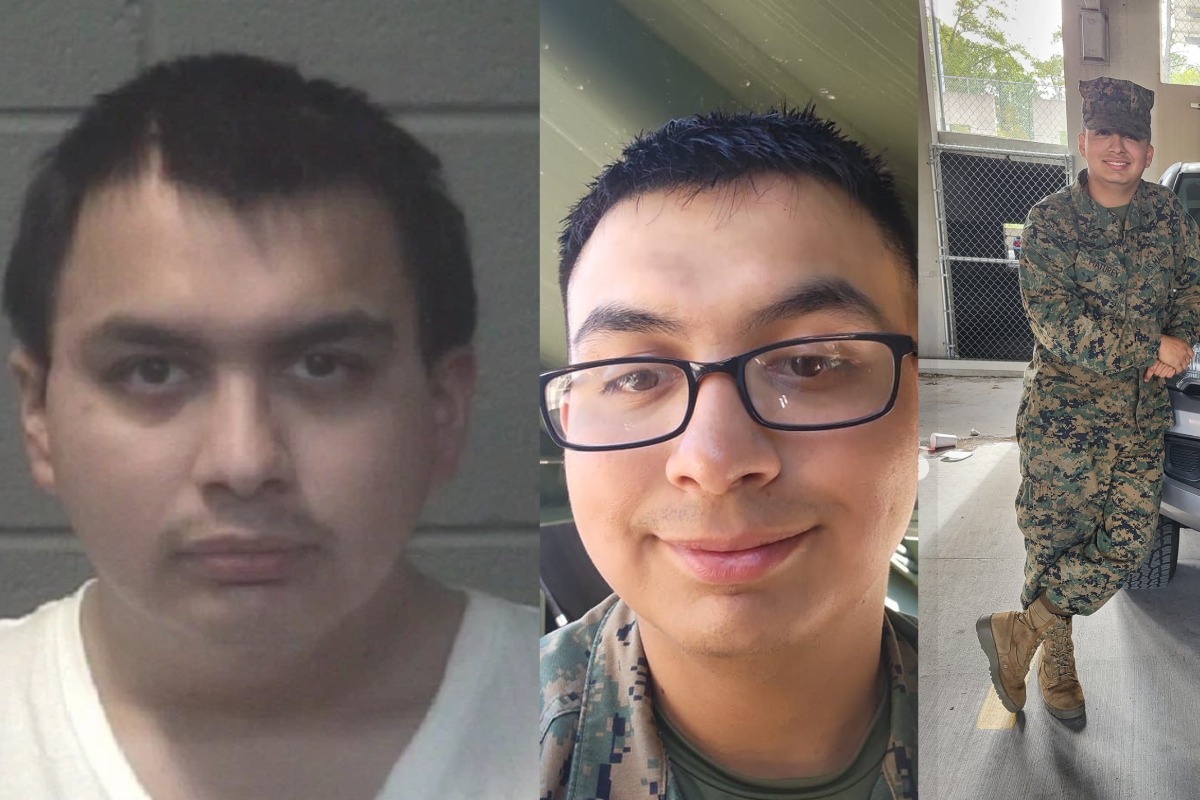
Daniel Montano, a 21-year-old Marine Lance Corporal stationed at Camp Lejeune, was killed during a chaotic downtown Wilmington brawl — an incident that is now drawing renewed scrutiny after video surfaced showing his final moments and the police response.
The Wilmington Police Department has since arrested Davy Spencer, 47, charging him with second-degree murder and two counts of assault with a deadly weapon with intent to kill. He is being held without bond.
According to investigators, officers were dispatched around 2 a.m. on April 5 to the 100 block of North Front Street — a crowded nightlife area known to attract Marines from nearby Camp Lejeune — after reports of multiple fights breaking out at once. By the time police arrived, the situation was already unstable, with multiple individuals involved and at least three victims ultimately tied to the incident.
Montano had been stabbed in the neck.
Video from the scene shows him still on his feet in the initial moments, hunched forward as he is bleeding heavily from the wound. But one detail stands out immediately — his face already appears extremely pale before any meaningful aid is rendered. That visual alone suggests the injury had already progressed into a critical stage.
Note: This article has been adapted for a general audience. Subscribers can view the full, uncensored version, including video evidence, on the subscriber platform.
Severe blood loss from a neck wound, particularly if a major artery is involved, can push the body into hypovolemic shock within minutes. As blood volume drops, the body redirects circulation away from the skin to preserve the brain and vital organs, leaving the face drained of color, the skin cold, and the patient rapidly deteriorating. By the time those signs are visible, the window to reverse the outcome is already closing.
The video captures what happens next.
A bystander — possibly another Marine — moves in and attempts to help, using his shirt to apply pressure to the wound as Montano weakens. That kind of immediate action is exactly what trauma care calls for in these situations: aggressive, uninterrupted pressure directly on the source of bleeding, sometimes combined with packing the wound to slow the hemorrhage.
At the same time, two officers positioned near Montano can be seen struggling to put on latex gloves while the bystander is already attempting to render aid.
But neck wounds are not straightforward. Unlike an arm or leg, there is no tourniquet option. The margin for error is almost nonexistent, and even when done correctly, survival depends on seconds — not minutes — and rapid follow-on care at a trauma center.
At the same time, officers can be seen working to secure the broader scene. They had responded to multiple fights, deployed pepper spray, and were entering an environment where it was not immediately clear who was a victim and who might still be a threat.
According to Wilmington Police Chief Ryan Zuidema, officers were dealing with a fluid and potentially dangerous situation. Department protocol requires protective measures, including gloves, before rendering aid, particularly in scenes involving heavy blood exposure. One officer had also been affected by pepper spray during the response.
From a procedural standpoint, those steps align with training.
From a viewer’s standpoint, watching a young Marine suffer a severe neck wound, they can appear delayed.
That tension — between protocol and urgency — is what now defines the public reaction to the footage.
It is also what makes the medical reality difficult to ignore. Uncontrolled hemorrhage is one of the leading causes of preventable death in trauma — and when a major artery is involved, especially in the neck, survival can come down to minutes. Not an hour. Minutes. Without immediate and effective bleeding control, the outcome is often decided before a victim ever reaches a hospital.
If the airway is compromised in a neck injury, the odds drop even further.
In this case, another victim from the same incident survived after officers applied a tourniquet — a far more straightforward intervention involving an extremity. Montano’s injury offered no such simplicity.
Whether a faster or different response would have changed the outcome is ultimately a question that cannot be definitively answered from video alone. What the footage does show, however, is how quickly the situation had already deteriorated by the time help was actively being rendered.
Montano, assigned to 1st Battalion, 2nd Marine Division, was described by his family as a dedicated Marine and a deeply loved son and brother.
His death is now part of an ongoing investigation, but also part of a broader and uncomfortable reality — that even off the battlefield, survival can come down to seconds, precision, and circumstances that don’t always allow either.
Authorities say the case remains active as evidence continues to be reviewed, including the video that has now become central to both the investigation and the public’s understanding of what unfolded that night.
© 2026 The Salty Soldier. All rights reserved. Reproduction without written consent is strictly prohibited.