
For more than thirty years, Americans have heard the same warning: Iran is getting close to a nuclear weapon. Months away. Maybe a year. Running out of time.
That warning has been repeated across decades—and across administrations.
So why, after all this time, did it suddenly become urgent enough to justify war in 2026?
For more than thirty years, Iran’s nuclear program has been framed as an approaching crisis—always close, always just over the horizon. From early warnings in the 1990s to repeated claims in the 2000s and 2010s, the message remained consistent: Iran was only months or years away from a nuclear weapon.
Those timelines came and went. The warnings did not.
In 2026, that same language of urgency returned—this time alongside a large-scale U.S. military campaign already underway.
The question isn’t whether Iran poses a threat. The question is why a threat described as “imminent” for decades became the basis for immediate war only now.
For years, Benjamin Netanyahu—Israel’s longest-serving prime minister and a central figure in shaping global perceptions of Iran’s nuclear ambitions—has warned that Tehran was nearing nuclear capability. In the 1990s, he placed the timeline at three to five years. By the early 2000s, that window narrowed to months. In 2012, he stood before the United Nations with a diagram of a cartoon bomb, warning that Iran was approaching a “red line.”
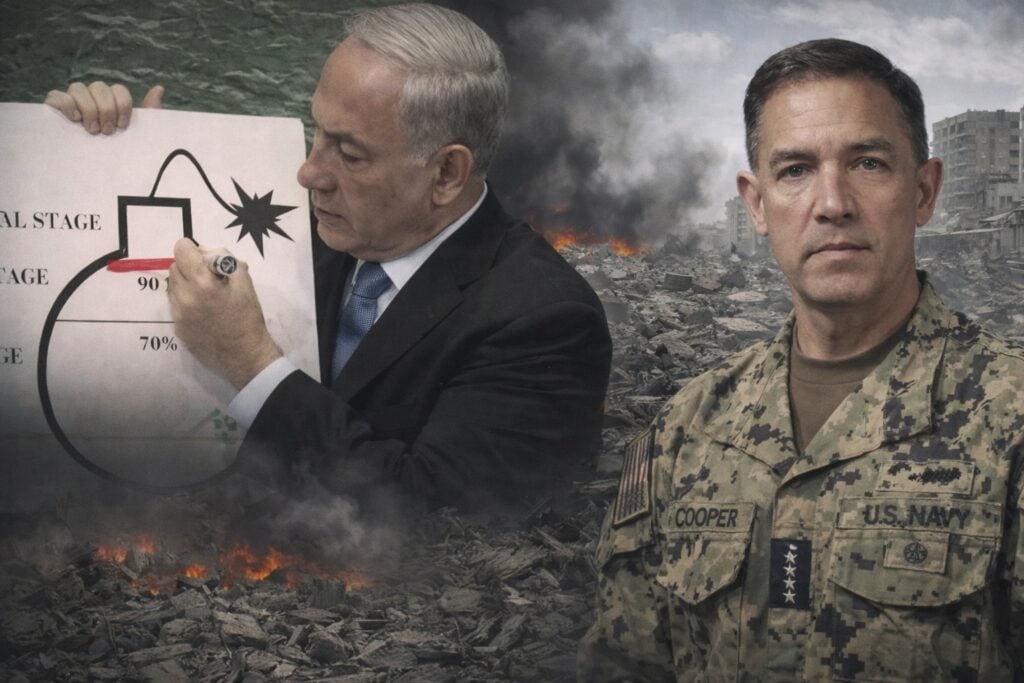
The language remained consistent: Iran was getting closer, and time was running out.
Yet those predictions—often measured in months or a few years—never materialized within the timeframes described.
That does not mean the threat was imaginary. Iran has pursued nuclear technology, advanced enrichment capabilities, and developed missile systems that pose real risks across the region. But the timeline of urgency has been repeatedly compressed in public rhetoric, even as intelligence assessments have remained more measured.
A 2025 U.S. intelligence assessment projected that Iran’s ability to field a missile capable of reaching the American homeland could still be years away—potentially into the next decade.
At the same time, public statements from senior officials emphasized a far more immediate danger—describing a threat that could “soon” reach the United States.
That gap between assessment and rhetoric is not new. What is new is not the warning—but what followed.
By the time the first strikes of Operation Epic Fury were announced in February 2026, the infrastructure for war was already in place.
Brad Cooper, a U.S. Navy admiral and the commander of United States Central Command—the military command responsible for U.S. operations across the Middle East—was already in position.
Notably, Cooper is only the second naval officer in history to lead CENTCOM, a command traditionally led by Army and Marine generals during decades of ground wars in Iraq and Afghanistan.
He is not just any leader—he is a career surface warfare officer whose experience is built around maritime operations and power projection.
Before taking command in August 2025, Cooper led U.S. Naval Forces Central Command, the Fifth Fleet, and Combined Maritime Forces in Bahrain—positions directly tied to operations in the Persian Gulf and surrounding waters.
He has spent his career operating in exactly the environment where this war is now unfolding.
The timeline is not compressed—it is layered.
- August 2025: Cooper assumes command of CENTCOM
- Late 2025: Tensions with Iran continue to rise
- January 2026: U.S. forces begin positioning across the region
- February 2026: Targeting and operational planning are finalized
- February 28, 2026: Strikes begin under Operation Epic Fury
By the time the war was presented as a reaction, it had already been prepared.
Public messaging, however, told a simpler story.
Officials described a sequence in which Israel informed the United States of impending action, and the U.S. chose to join in support of an ally. The framing was reactive: a response to escalation, not the initiation of a broader campaign.
But wars of this scale don’t begin in a matter of days.
They begin months earlier—when commanders are selected, forces are positioned, and targets are identified.
This tension between public urgency and measured intelligence assessments is not without precedent.
In the lead-up to the Iraq War, Americans were told that weapons of mass destruction posed an urgent and immediate threat. Years later, no stockpiles were found. The outcome did not align cleanly with the primary justification.
What followed was a broader reassessment—one that shifted attention toward other outcomes: regime change, regional influence, and the long-term restructuring of Iraq’s political system.
A similar pattern can be seen in the War in Afghanistan. The initial objective was clear: dismantle al-Qaeda and target Osama bin Laden following the attacks of September 11, 2001. That mission expanded into a two-decade war. Bin Laden was ultimately killed in 2011—not in Afghanistan, but in Pakistan—and the conflict continued for another decade. When U.S. forces withdrew in 2021, the Taliban returned to power.
Together, these conflicts illustrate a recurring reality: the reasons given at the outset of a war do not always define how it is fought—or how it ends—often leaving the public questioning how years of conflict and trillions of dollars in spending produced outcomes that do not clearly align with the original justification.
Public reaction to the current conflict reflects that history.
Among veterans, analysts, and everyday observers, a different question has emerged: if there is no immediate threat to the American homeland, why does the scale and preparation of this campaign look so extensive?
Some argue the United States is acting primarily in support of Israel’s national defense. Others point to a broader pattern—one where military action is preceded by months of preparation, leadership alignment, and force positioning that suggest a level of intent beyond a rapid response.
That pattern is difficult to ignore.
For some, that raises a broader question: whether the nuclear threat cited publicly is the sole driver of the war, or one part of a larger strategic picture.
That picture includes factors rarely stated outright but well understood in policy circles—control of critical shipping lanes, stability of global energy markets, and long-term competition among major powers for influence in key regions.
None of this negates the reality of Iran as an adversary.
But it does complicate the explanation.
History offers a reminder of what is at stake when threat, timing, and decision converge into war.
In Iraq, more than 4,400 American service members were killed and tens of thousands wounded. For Iraqis, civilian deaths reached into the hundreds of thousands, with some estimates far higher when including indirect effects of war.
In Afghanistan, a two-decade conflict resulted in roughly 2,400 U.S. service member deaths and more than 20,000 wounded, along with thousands of American contractors and civilians killed. Afghan military and police forces suffered tens of thousands of losses, while civilian deaths ranged into the tens of thousands. In total, the war resulted in well over 170,000 deaths and cost more than $2 trillion.
The exact figures may be debated. The scale—and the cost—are not.
War does not remain contained to strategy briefings or press statements. It moves through people—through those sent to fight, through families who wait, and through civilians who live where those decisions land.
That is what gives urgency its weight.
If the justification for war rests on claims that action is necessary now, then the burden is not just to act—but to be right.
So the question remains:
Did the threat suddenly become urgent?
Did the conditions for acting on a long-standing threat finally align?
Or do the scale, preparation, and early outcomes of this war suggest that broader strategic priorities—military, economic, and geopolitical—played a role in shaping both the timing of the conflict and what success is intended to look like?
And as with past conflicts, another question lingers just beyond the moment:
Will the intense scrutiny that accompanies the justification for war remain in the years that follow—or will it fade, as outcomes evolve and new realities take hold, leaving the public to reconcile the costs only after the fact?
Because once the decision is made, it is no longer a question of policy.
It becomes a matter of consequence.
© 2026 The Salty Soldier. All rights reserved. Reproduction without written consent is strictly prohibited.