U.S. military installations across the Persian Gulf came under missile attack Saturday after Iran launched retaliatory strikes following a major joint U.S.-Israeli military campaign against Iranian targets.
Iran’s Islamic Revolutionary Guard Corps (IRGC) targeted American positions in Bahrain, Qatar, Kuwait, and the United Arab Emirates, according to multiple regional and international reports.
Fifth Fleet Headquarters Struck
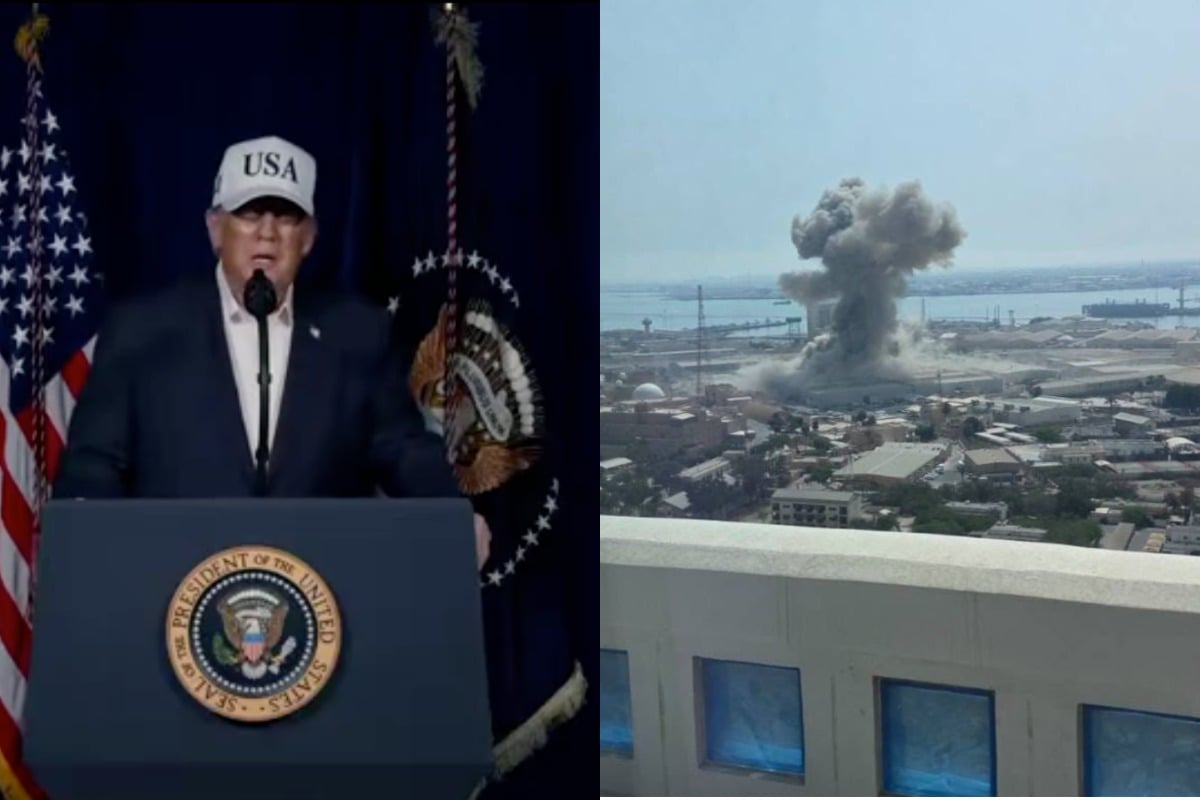
Iranian ballistic missiles struck a facility associated with U.S. Naval Forces Central Command (NAVCENT) and the U.S. Navy’s Fifth Fleet on Saturday, according to Bahraini officials and Iranian state-linked media.
The impacted facility is located at Naval Support Activity (NSA) Bahrain in Manama — the permanent headquarters for:
- U.S. Naval Forces Central Command (NAVCENT)
- U.S. Fifth Fleet
- Combined Maritime Forces (CMF)
Bahrain’s National Communication Centre confirmed that a “service center affiliated with the Fifth Fleet” was hit in what it described as a missile attack. Iranian outlets Fars and Tasnim reported the strike was part of a broader ballistic missile retaliation campaign against U.S. military infrastructure in the Gulf.
Air raid sirens were activated across the island nation, and the Bahraini Interior Ministry instructed residents to move to safe locations.
Naval Support Activity Bahrain supports thousands of U.S. Navy personnel and is one of the only accompanied-duty stations in the U.S. Central Command area of responsibility, meaning service members may have families stationed there.
The installation serves as the command hub for American maritime operations across the Persian Gulf, Arabian Sea, Red Sea, and parts of the Indian Ocean.
Missile attack hits US Navy Fifth Fleet base in Bahrain after US-Israel strikes on Iran. pic.twitter.com/LykiKqHjtF
— ArcZeal Designs (@arczeal_designs) February 28, 2026
Qatar Intercepts Missiles
Qatar confirmed that its air defense systems intercepted two Iranian missiles. The country hosts Al Udeid Air Base, the largest U.S. military installation in the Middle East and the forward headquarters of U.S. Central Command (CENTCOM) and U.S. Air Forces Central (AFCENT).
Emergency sirens were reported near U.S. facilities.
UAE Reports Fatality After Interceptions
In the United Arab Emirates, authorities said multiple Iranian missiles were intercepted. However, falling debris struck a residential area in Abu Dhabi.
Abu Dhabi, home to Al Dhafra Air Base, which hosts U.S. Air Force personnel and advanced aircraft assets.
UAE state media reported material damage and the death of one civilian described as a person of Asian nationality. Civil aviation authorities announced a temporary and partial closure of national airspace as a precautionary measure.
Residents reported hearing loud explosions in the Emirati capital.
Kuwait and Regional Alerts
Iranian outlets claimed U.S. facilities in Kuwait were targeted. Kuwait hosts several U.S. Army installations including Camp Arifjan, Ali Al Salem Air Base, and Camp Buehring, which support U.S. Army Central (ARCENT) logistics and regional force projection.
No confirmed strike damage has been publicly acknowledged in Kuwait as of publication.
Sirens were also reported in Jordan, which hosts key U.S. air assets used in regional operations.
Pentagon Authorizes Departure of Military Families
The Department of Defense has authorized the voluntary departure of military dependents stationed in Bahrain. The move is not mandatory but allows families to leave on a first-come, first-served basis.
The alert reportedly went out to service members shortly after explosions were reported in Tehran earlier Saturday.
Bahrain remains one of the few accompanied-duty locations in the Central Command area of responsibility.
U.S. embassies in Bahrain, Qatar, and Israel issued emergency notices advising American citizens to shelter in place with food, water, and medicine.
President Confirms Combat Operations
In an eight-minute video message posted Saturday, President Donald Trump confirmed that the United States had launched what he described as a “major combat operation” against Iran, in coordination with Israel.
The stated objective, according to the president, is to prevent Iran from obtaining a nuclear weapon.
He acknowledged the potential for American casualties.
“The lives of courageous American heroes may be lost,” he said. “That often happens in war. But we’re doing this not for now — we’re doing this for the future.”
President Donald J. Trump on the United States military combat operations in Iran: pic.twitter.com/LimJmpLkgZ
— The White House (@WhiteHouse) February 28, 2026
He also directly addressed the Iranian population, urging them to remain indoors during strikes and suggesting they seize an opportunity to change their government after hostilities conclude.
Escalation Across the Region
The Iranian missile barrage marks the most direct large-scale confrontation between the United States and Iran in years and signals rapid escalation following weeks of mounting tensions.
The region had already seen increased U.S. naval and air deployments as diplomatic negotiations over Iran’s nuclear program deteriorated.
As of this publication, damage assessments remain ongoing. U.S. Central Command has not yet released an official battle damage assessment.
This is a developing story and will be updated as additional information becomes available.
© 2026 The Salty Soldier. All rights reserved.