Army National Guard program is sending new enlistees to Ranger School and other sought-after courses before they reach their first units, highlighting a dramatic difference in how soldiers gain access to advanced military training.
For many soldiers, attending Ranger School, Airborne School or another coveted Army course can mean years of waiting, competing for limited openings or even reenlisting to secure a slot.
But some Army National Guard recruits are completing several of those schools before they ever report to their first units.
Two young Iowa Army National Guard soldiers are among the latest examples.
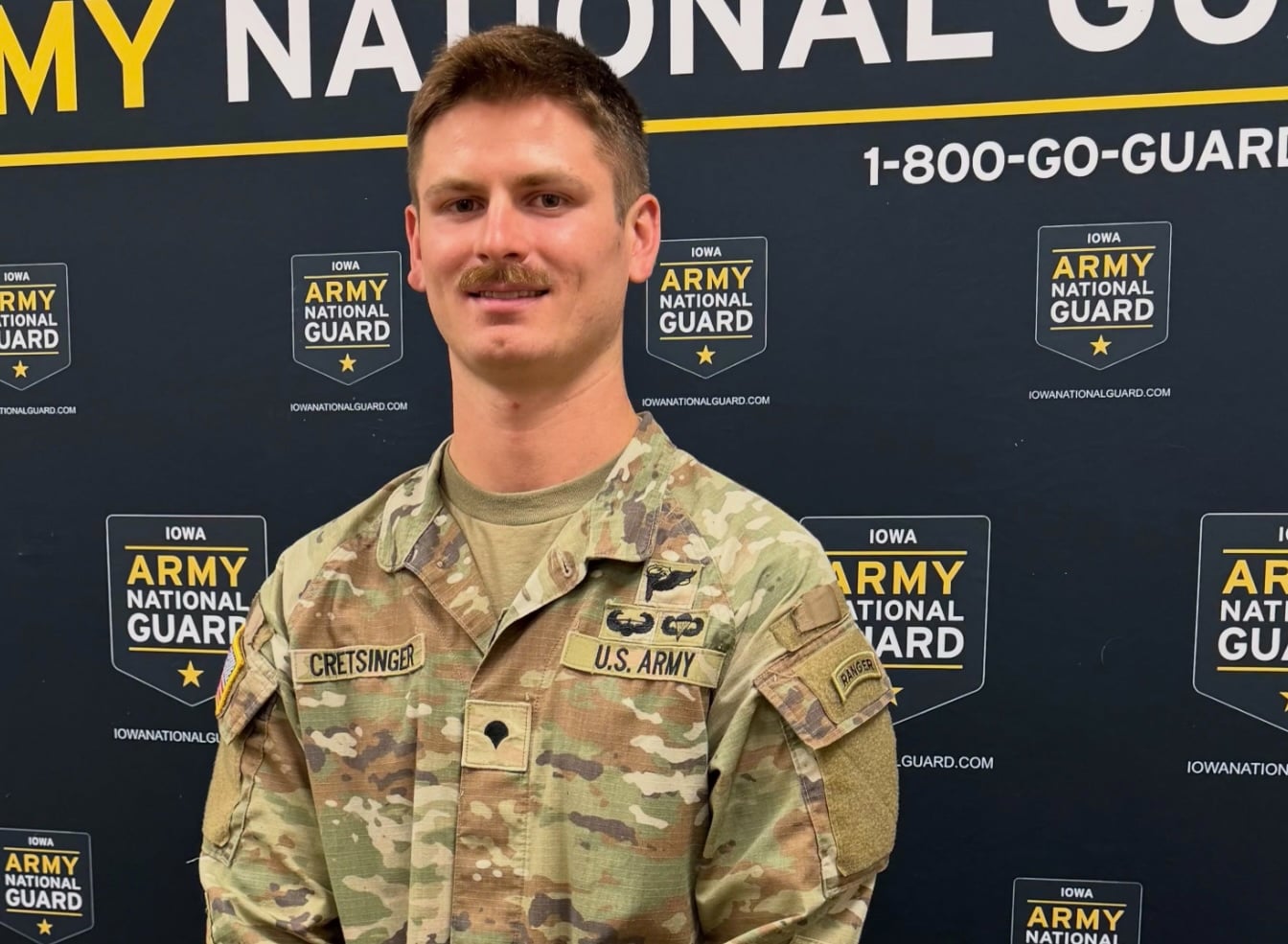
Spc. Franklin Cretsinger, 21, completed Ranger School, Airborne School, Air Assault School, Pathfinder School and the Rappel Master Course, according to a Facebook announcement by Iowa Army National Guard Recruiting.
Spc. Colin Winborn, 22, completed Ranger School and Airborne School.

Both accomplished those milestones within their first year of military service, before receiving their unit patches, according to the recruiting announcement.
Their achievements are impressive. Ranger School alone is among the Army’s most demanding leadership courses, and completing multiple specialized schools requires considerable physical and mental preparation.
But the announcement also highlights something that may surprise soldiers who have spent years trying to obtain similar training opportunities.
The Army National Guard has an established program that allows select recruits to move directly from initial entry training into some of the Army’s most sought-after schools, without first spending years at an operational unit competing for those opportunities.
And some veterans are questioning how those school slots are being distributed.
From basic training to Ranger School
The Ranger Team Leader Initiative, known as RTLI, was established in 2017 to identify promising Army National Guard soldiers during initial military training and prepare them for Ranger School.
Instead of waiting until soldiers have gained experience at their assigned units, the program identifies qualified volunteers during One Station Unit Training, or OSUT, at Fort Benning, Georgia.
Selected soldiers receive additional preparation through RTLI before advancing to the Ranger Training Assessment Course, the National Guard’s pre-Ranger program. Those who successfully complete the required training can then attend Ranger School.
In a December 2019 Army article, Col. Michael Scarpulla, then commander of the Airborne and Ranger Training Brigade, acknowledged how unusual it was for soldiers to attend Ranger School immediately after initial training.
He explained that soldiers typically spent a year or two at their units gaining practical experience before attempting the course, if they received the opportunity at all.
RTLI changed that approach for selected National Guard recruits.
The program can also lead to additional training. Soldiers who complete Ranger School may receive opportunities to attend Airborne School and courses offered through the Army National Guard Warrior Training Center, including Air Assault, Pathfinder and Rappel Master training.
Those opportunities are not guaranteed. Soldiers must meet the requirements for each course, and attendance depends on available training seats.
In the comments beneath the Iowa recruiting announcement, Robert Pelczarski described how high-performing soldiers can progress through the program, earning opportunities to attend additional schools as they complete each stage.
Pelczarski said the follow-on opportunities are not included in the soldiers’ original enlistment contracts and depend on performance, eligibility and scheduling.
The Iowa recruiting announcement did not specify whether Cretsinger and Winborn participated in RTLI.
Veterans recall struggling to obtain the same opportunities
While the Iowa National Guard’s announcement recognized the accomplishments of Cretsinger and Winborn, it also drew reactions from veterans who remembered a different process for securing coveted Army schools.
Derick Konungr, commenting on the recruiting announcement, questioned whether making so many advanced schools available to new soldiers diminishes the exclusivity traditionally associated with those opportunities.
Konungr said soldiers once had to arrive at their units, demonstrate their abilities and compete for school slots.
“While I take nothing away from their accomplishments (they should be stupid proud and very thankful for such opportunity), seeing the Army hand out these schools makes it look more like candy than achievement,” he wrote.
Another commenter, Yuri LD, identified himself as a combat veteran who served nine years in the Army between 1999 and 2010.
“When I was in, 1999-2002, 2004-2010 just getting one of those schools could be near to impossible,” he wrote.
Yuri recalled repeated deployments to Iraq that lasted 12 to 15 months, followed by roughly a year stateside before another deployment. He described soldiers accumulating multiple lengthy combat tours while opportunities for advanced schooling remained limited.
He also recalled that some soldiers had to reenlist to secure coveted training opportunities.
His reaction was not criticism of the Iowa soldiers’ accomplishments. Rather, he expressed amazement that two soldiers could complete so much training in such a short period.
“Then the other thing that is crazy is the time frame. When did the military paperwork process work so well?” he wrote.
The contrast reflects a reality familiar to many veterans who served during the wars in Iraq and Afghanistan. Deployments, staffing requirements and competing operational priorities could make attendance at advanced schools difficult, regardless of a soldier’s qualifications or motivation.
For some, obtaining a school slot was an accomplishment in itself.
The program extends beyond Iowa
Cretsinger and Winborn are not isolated examples of new National Guard soldiers completing multiple advanced schools.
On Oct. 15, 2026, the Army published a feature about Pfc. Dakota McConnell, a Washington Army National Guard infantryman who enlisted in May 2025.
After completing his initial training, McConnell participated in RTLI and graduated from Ranger School, Airborne School, Air Assault School, the Rappel Master Course and Pathfinder School.

McConnell told the Army that additional training opportunities continued to become available as he completed each school. Despite being physically exhausted from months of training, he continued accepting opportunities to attend additional courses.
A month earlier, the Army highlighted Pvt. Matthew Scaccia, a New Hampshire Army National Guard soldier who completed infantry training, Ranger School and Airborne School before reporting for his first official drill weekend.
Scaccia completed the nearly 10-month training sequence without having to repeat any portion of Ranger School, according to the Army.

These examples illustrate a deliberate National Guard effort to identify promising young soldiers and provide advanced training early in their careers.
Army officials have described the initiative as a way to strengthen National Guard units by bringing Ranger-qualified junior soldiers into operational formations, where their training can benefit other soldiers and improve unit readiness.
But the approach also raises questions about how the Army allocates valuable training opportunities among new recruits and soldiers already serving in operational units.
Who gets priority for coveted school slots?
For many soldiers, school attendance depends on available training allocations, funding, unit requirements and command approval.
Those considerations can leave otherwise qualified soldiers waiting months or years for opportunities that may never materialize.
RTLI provides selected National Guard recruits with a structured route to Ranger School before they arrive at their assigned units. Some graduates can then attend additional courses through the Warrior Training Center and other Army schools.
Whether those opportunities represent additional training capacity or compete with seats that might otherwise be available to experienced soldiers remains an important distinction.
The Salty Soldier plans to seek answers from Army and National Guard officials about how many advanced school slots are allocated to RTLI, how those opportunities are funded and whether prioritizing new recruits affects the availability of those same schools for experienced soldiers already serving in operational units.
We also want to know whether the program is expanding training opportunities or changing who receives priority for a limited number of seats.
We plan to follow up with Army and National Guard officials and report what we learn.
The training itself is no giveaway. Cretsinger, Winborn and the other young National Guard soldiers still had to meet the Army’s graduation standards. But earning those qualifications is different from gaining the opportunity to attend the schools in the first place.
For veterans who spent years competing for training slots, the difference is striking. These recruits are receiving opportunities early in their careers that some soldiers never receive at all.
The question isn’t whether these young soldiers earned their qualifications. It’s how the Army decides who gets the opportunity to earn them.
© 2026 The Salty Soldier. All rights reserved. Reproduction without written consent is strictly prohibited.