TINKER AIR FORCE BASE, Okla. — A career Airman who pleaded for mercy after admitting marijuana use, describing a divorce-driven collapse marked by depression, heavy drinking and suicidal thoughts, later pleaded guilty to using marijuana during a new period and was sentenced to a bad-conduct discharge.
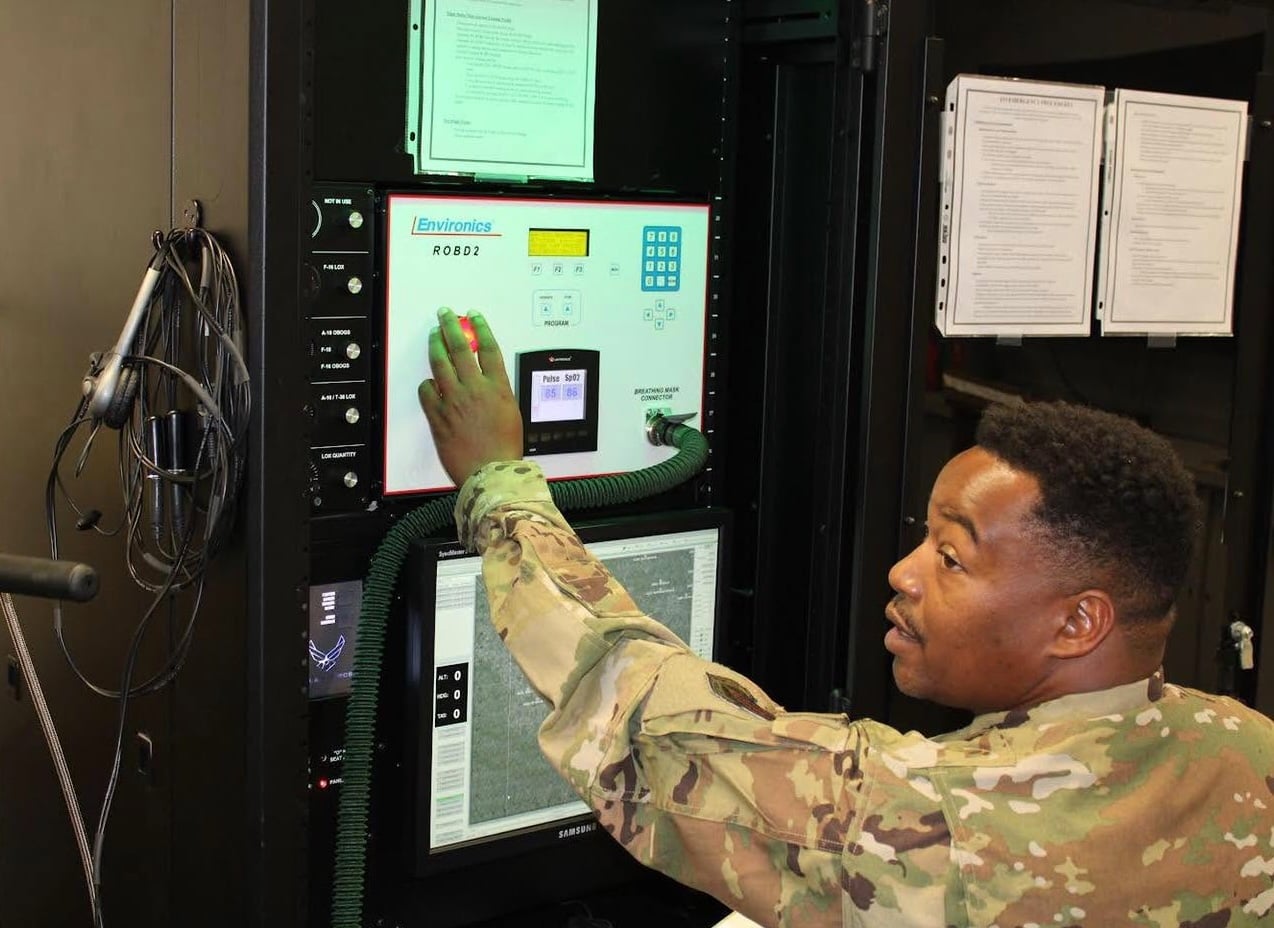
Staff Sgt. Kinyada J. Johnson, assigned to the 552nd Operations Support Squadron at Tinker Air Force Base, was convicted June 10 at a special court-martial of wrongfully using delta-9 tetrahydrocannabinol, or THC-9, on multiple occasions between Jan. 22 and June 9, 2025, according to Air Force court records.
Military Judge Lt. Col. Michael A. Schrama sentenced Johnson to a bad-conduct discharge and reduction from E-5 to E-3. Johnson received no confinement, fine, forfeiture of pay, restriction, hard labor or reprimand. The punishment placed nearly all of its weight on rank and the end of his Air Force career.
Johnson entered the guilty plea without a plea agreement, the statement of trial results shows. That means the available records contain no negotiated punishment ceiling or other deal explaining the sentence.
The court-martial came after commanders had already used nonjudicial punishment in response to an earlier period of misconduct and after Johnson had completed treatment.
On Feb. 3, 2025, Johnson was offered an Article 15 for failing to report as directed for a drug test in August 2024 and for using THC-9 on multiple occasions between approximately July 26, 2024, and Jan. 21, 2025. In a written response three days later, Johnson accepted responsibility and asked his commander for empathy.
Johnson wrote that his move to Oklahoma had followed the collapse of his 19-year marriage. He said his wife told him she was divorcing him and taking their daughter to Texas, leaving him without the support system on which he had depended for nearly two decades.
He described falling into a deep depression, feeling isolated and drinking at what he called an alarming rate while trying to cope with depression and suicidal thoughts. Johnson said the people around him enabled his drinking and that the environment eventually led him to marijuana.
Johnson told his commander he had completed inpatient rehabilitation and the Air Force Alcohol and Drug Abuse Prevention and Treatment program. He said he now had tools and people who could help him manage stress, recognized the importance of his job as an aerospace physiology technician and would take every precaution to prevent the misconduct from happening again.
The commander nevertheless found him responsible in the Article 15 proceeding, reduced him from technical sergeant to staff sergeant and imposed forfeiture of $500 per month for two months, according to later court filings. Johnson appealed, again discussing his depression, financial obligations and dissatisfaction with his work life at Tinker.
But the cutoff between the two cases was razor thin. The Article 15 covered alleged marijuana use through Jan. 21, 2025. The eventual court-martial charge began the following day.
Government filings identify 13 positive THC-9 urinalyses within that new charging period. The first sample was collected Jan. 31, six days before Johnson submitted his plea for mercy. The other 12 came afterward, on dates ranging from Feb. 10 through June 9.
The reported concentration dropped from 388 nanograms per milliliter on Jan. 31 to 88 and then 83 in February. It subsequently climbed to 146, 494, 659, 627 and 957 across later tests. Records show additional reported levels of 840 in April, 1,450 later that month and 2,105 on May 5. The military confirmation cutoff was 15 nanograms per milliliter.
A succession of positive tests does not necessarily prove a separate marijuana use for every sample because THC metabolites can remain in the body. The government, however, planned to call a forensic toxicologist who would testify about whether the results were consistent with multiple uses and whether the concentrations reasonably discounted unknowing ingestion.
The government also pursued evidence it said showed knowledge and efforts to avoid detection. In a May filing, prosecutors said Amazon records showed Johnson purchased three THC detox powder supplements on Feb. 7, 2025—the day after submitting his written apology. Prosecutors also identified alleged purchases of home drug-testing kits and other detox products before, during and after the charged period.
Those purchases were prosecution allegations contained in evidentiary notices, not separate offenses of which Johnson was convicted. Similarly, the government alleged that Johnson continued testing positive in January and February 2026, after the charged period and after the court-martial charge had been filed.
Johnson’s defense initially prepared to fight the case. A Jan. 30 notice said that, “at this time,” he intended to plead not guilty and be tried by a mixed panel of officers and enlisted members. The document described those as probable pleas, leaving Johnson free to change them.
Defense lawyers obtained a forensic toxicology consultant, challenged the reliability and admissibility of laboratory records and raised the possibility that lawful hemp-derived products could cause a positive urinalysis. They also argued that a laboratory result alone did not automatically establish knowing and wrongful use.
The defense won a significant pretrial ruling. On March 4, Schrama excluded Johnson’s earlier admissions, earlier drug use and a January 2026 positive test from the government’s main case under Military Rule of Evidence 404(b). The judge found that using those matters merely to portray Johnson as a habitual drug user created an unfair risk that panel members would convict him because of perceived bad character.
Schrama left open whether some of the evidence could be used later if the defense raised innocent ingestion, lack of knowledge or mistake. In a separate ruling, the judge allowed the government to pre-admit records associated with the 13 urinalyses from the charged period.
The defense was still preparing for a contested trial as late as May 26, when it submitted proposed questions for prospective panel members. Those questions focused on the presumption of innocence, the accuracy of military drug testing, chain-of-custody concerns, possible contamination and whether a person could unknowingly consume a controlled substance.
Two weeks later, Johnson appeared before a military judge, pleaded guilty and elected judge-alone sentencing. The final judgment does not explain why he changed course, and the available records do not include the guilty-plea inquiry, sentencing arguments or Johnson’s unsworn sentencing statement.
The timing suggests the defense position became increasingly difficult as prosecutors assembled the charged laboratory records, toxicology testimony, additional positive tests, earlier admissions and alleged detox purchases. That is an inference from the filings, not an explanation provided by Johnson or his attorneys.
The record also complicates any claim that Johnson was punished simply because he was honest or asked for help. His admissions and description of severe mental-health struggles were real and potentially powerful mitigation. But they concerned the earlier Article 15 period. The court-martial addressed continued use during a new period, including 12 positive tests collected after Johnson told his commander he would ensure the misconduct never happened again.
Johnson’s precise length of service is not stated in the final judgment. Other records show Air Force service dating back at least to 2012, while his pay information and expressed fear of losing retirement indicate that substantial career and retirement interests were at stake.
Although Johnson was sentenced to a bad-conduct discharge on June 10, the available records do not establish that he immediately left the Air Force. Because a punitive discharge generally cannot be carried out until the required post-trial review is complete, the judgment shows that his military career is set to end but does not reveal when the discharge will take effect.
Johnson’s case presents two truths at once: an Airman described a serious personal and mental-health crisis and sought mercy after admitting misconduct, and military records show that the marijuana use continued after treatment, punishment and a promise to stop.
The judge imposed no jail time but delivered the punishment Johnson had reportedly feared most—the loss of his rank and Air Force career.
© 2026 The Salty Soldier. All rights reserved.