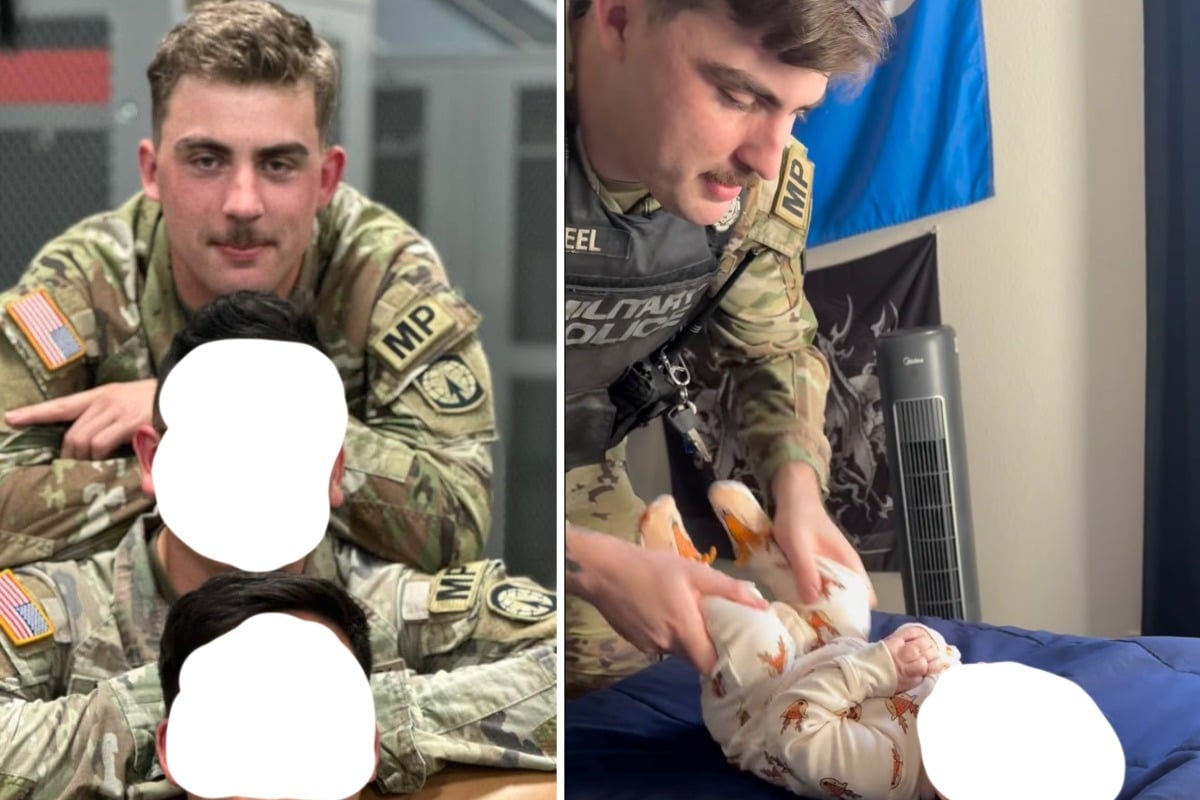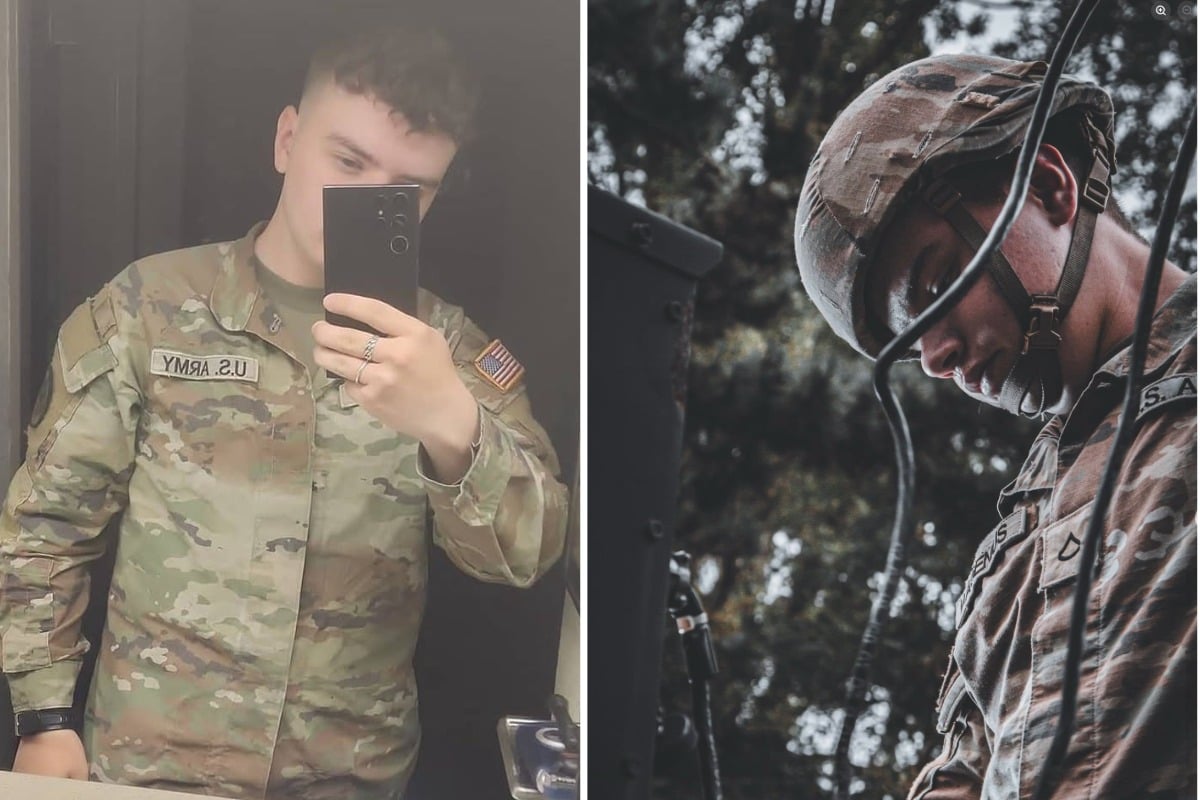
Sgt. 1st Class Kristen Schuch sits inside a vehicle wearing an Army uniform. Her name tape is visible. So is the rank insignia identifying her as an E-7.
Then money enters the conversation.
“why do y’all ask if I ate if you’re not gonna send me no money?” Schuch says in a TikTok posted July 7.
The caption reads, “I’m so confused why ask?” followed by hashtags including #army, #strongwoman, #eat and #money.
One viewer responded: “cause you getting that E7 pay compared to lower enlisted pay.”
Whether Schuch was seriously asking followers to send her money, joking with her audience or simply trying to drive engagement is something only she can fully explain.
What is harder to dispute is that the Army was part of the presentation.
She was in uniform. Her new senior NCO rank was visible. The post was tagged #army. And at least some viewers immediately connected what she was saying about money to her military pay.
@bubbly.snowflake_._ I’m so confused why ask? #fyp #army #strongwoman #eat #money ♬ original sound – Kristen Alexandra
That post is only one piece of a much larger social-media presence in which Schuch’s Army service repeatedly becomes content.
Her Instagram account, bubbly.snowflake__, showed approximately 20,700 followers when reviewed by The Salty Soldier. On Facebook, she prominently identifies herself as a “92A at New York Army National Guard.”
Army uniforms, rank, promotions, military pay, housing allowances, benefits and military hashtags appear throughout posts reviewed by The Salty Soldier.
More recently, Schuch posted videos introducing herself as “SFC Schuch.” The Instagram version appeared several weeks before a substantially similar TikTok post.
After being promoted top Sergeant First Class in March of this year, most of her content posted to social media involves her now being a senior NCO.
That makes the larger question harder to ignore:
How far can a Soldier separate a “personal” social-media account from the Army when being a Soldier is one of the central features of the brand?
Money and military compensation have appeared in Schuch’s content before.
One older Instagram Reel was captioned:
“Collecting that NYC BAH though 💰”
The post included hashtags for the Army, military, money and BMW.
Receiving Basic Allowance for Housing is not evidence of misconduct. Eligible National Guard members can receive housing allowances while serving under qualifying orders.
The importance of the post is not that Schuch received BAH.
It is that military compensation became content.
In another video, Schuch referenced having spent two years on active-duty orders while serving in the National Guard.
Official military imagery also confirms Schuch’s connection to the New York National Guard. In February of 2021 the Army identified Sgt. Kristen Schuch as a logistics supply NCO assigned to the 133rd Composite Supply Company, 369th Sustainment Brigade, 53rd Troop Command. She was photographed supporting COVID-19 vaccination operations at the Javits Convention Center in New York City.
At the time, she was a sergeant.
Her social-media content documents the progression from sergeant, to staff sergeant, to someone now publicly identifying herself as SFC Schuch.
But the Army is not Schuch’s only uniformed career.
Public payroll records identify Kristen Schuch as a New York City correction officer, including as recently as 2025.
Schuch herself acknowledged that career in a December 2022 Instagram post showing her with other correction officers.
“5.5 years later!!!! We made it,” text placed over the video reads. “I’m officially at top pay making six figures at 29 years old.”
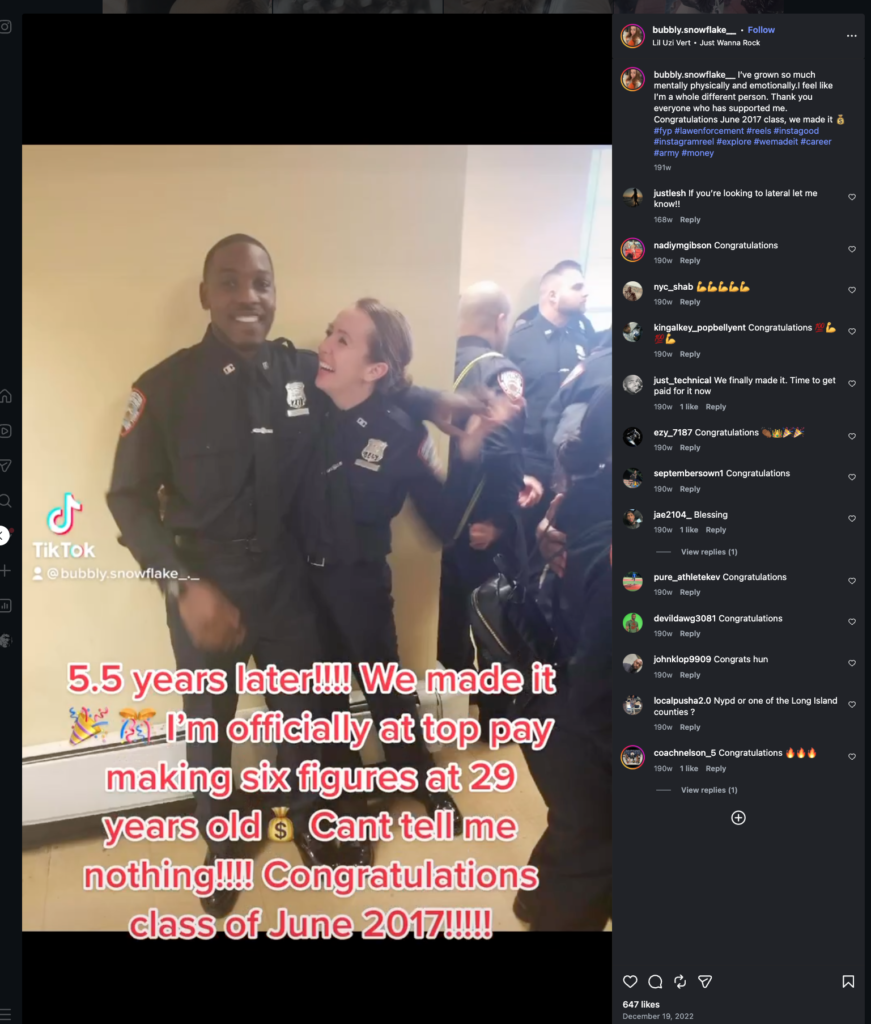
The post referenced the June 2017 correction officer class.
She appears to have spent years working in two uniformed public-service professions.
Yet one dominates her public identity while the other is barely visible.
Her Facebook profile identifies her Army occupation, not her correction job. Army uniforms appear repeatedly. Her military MOS is displayed. Her promotions become content. Military pay and benefits become content. Army hashtags are regularly attached to posts.
Her correction-officer career, despite Schuch herself describing it as a six-figure job, appears only once.
The contrast raises a legitimate question about whether military identity has become more than biographical information.
When the uniform, rank, pay, promotion and benefits are repeatedly part of the content itself, the Army is no longer sitting quietly in the background.
Schuch has also publicly discussed disability-related issues.
In one Instagram video, she is shown receiving chiropractic treatment while discussing scoliosis that she said had been diagnosed during childhood.
In the comments, another user wrote “100 percent service connected” followed by a laughing emoji.
Schuch replied: “same 🙏🏽”
Army social-media guidance encourages Soldiers using personal accounts to make clear that their views are their own. But it separately warns Soldiers against using military titles, insignia, uniforms or official positions in ways that could imply government endorsement or support private gain.
Army legal guidance has gone further.
A 2025 ethics discussion published in The Army Lawyer addressed government employees who monetize social-media accounts while referencing their government service. It warned that a disclaimer is “not always sufficient.”
Instead, the circumstances matter.
Among the factors considered are whether a person prominently displays a uniform, title, agency affiliation or official position and whether the overall presentation could cause a reasonable person to believe the government sanctions the activity.
That distinction is important.
A disclaimer can tell viewers that a Soldier is not officially speaking for the Department of War.
It does not make the uniform disappear.
It does not make rank disappear.
And it does not automatically eliminate ethics questions when military identity becomes intertwined with personal financial activity, monetized content or efforts to build an audience.
None of the material reviewed by The Salty Soldier establishes that Schuch has committed a crime, defrauded the VA or been formally found to have violated Army ethics or social-media rules.
Those distinctions matter.
There is also an additional complication because Schuch serves in the National Guard rather than the Regular Army.
National Guard Soldiers are not continuously subject to federal military jurisdiction in the same manner as active-duty Soldiers. Whether the federal Uniform Code of Military Justice applies can depend on the Soldier’s duty status when the conduct occurred. State military law and administrative authorities can also come into play.
That makes the question of punishment more complicated than simply identifying a regulation and asking whether someone violated it.
But jurisdiction and disclaimers are two different issues.
The larger question remains whether a senior NCO can make Army service a central feature of a large personal social-media presence, repeatedly appear in uniform, highlight military compensation and benefits, incorporate rank into the content and discuss money with followers — then completely separate that activity from the Army by placing a disclaimer somewhere on the account.
Army guidance suggests the answer is not that simple.
Senior NCOs are also not junior Soldiers learning where the boundaries are for the first time.
Sergeants first class occupy positions of significant responsibility. They supervise Soldiers, influence junior NCOs and are expected to model professional judgment.
That does not mean an SFC loses the right to have a personal social-media account, make jokes, build a following, earn money legally or discuss her life outside the Army.
It does mean a disclaimer should not be mistaken for immunity.
Schuch’s social-media presence provides an unusually clear example of why.
She has another government career that receives relatively little attention online.
The Army, meanwhile, is everywhere.
The uniform is there.
The rank is there.
The pay is there.
The benefits are there.
The promotion is there.
And sometimes, so is the money.
Whether Schuch believes that creates any conflict with her responsibilities as a senior NCO is a question she should have the opportunity to answer.
So should the New York Army National Guard.
Because “not a Department of War representative” may explain whose opinions are being expressed.
It does not necessarily answer what happens when being a representative of the Army is what helped build the audience in the first place.
© 2026 The Salty Soldier. All rights reserved. Reproduction without written consent is strictly prohibited.