Most Americans have never heard of Section 622.
Buried deep inside the Senate’s Intelligence Authorization Act for Fiscal Year 2027, the provision has received little mainstream attention despite being sponsored by one of the most powerful lawmakers in Washington: Senate Intelligence Committee Chairman Tom Cotton.
On its face, the language appears straightforward. The measure directs the executive branch to expand and enhance intelligence sharing with Israel while making it more difficult for future administrations to reduce that cooperation without presidential intervention and congressional notification.
Supporters describe the provision as a natural extension of a long-standing intelligence partnership between two allies facing common threats.
Critics see something more significant.
They argue that Congress is quietly moving beyond traditional alliance management and toward a level of institutionalized intelligence integration that receives little public debate despite potentially affecting future U.S. foreign policy for years to come.
The proposal becomes even more notable when considering who introduced it.
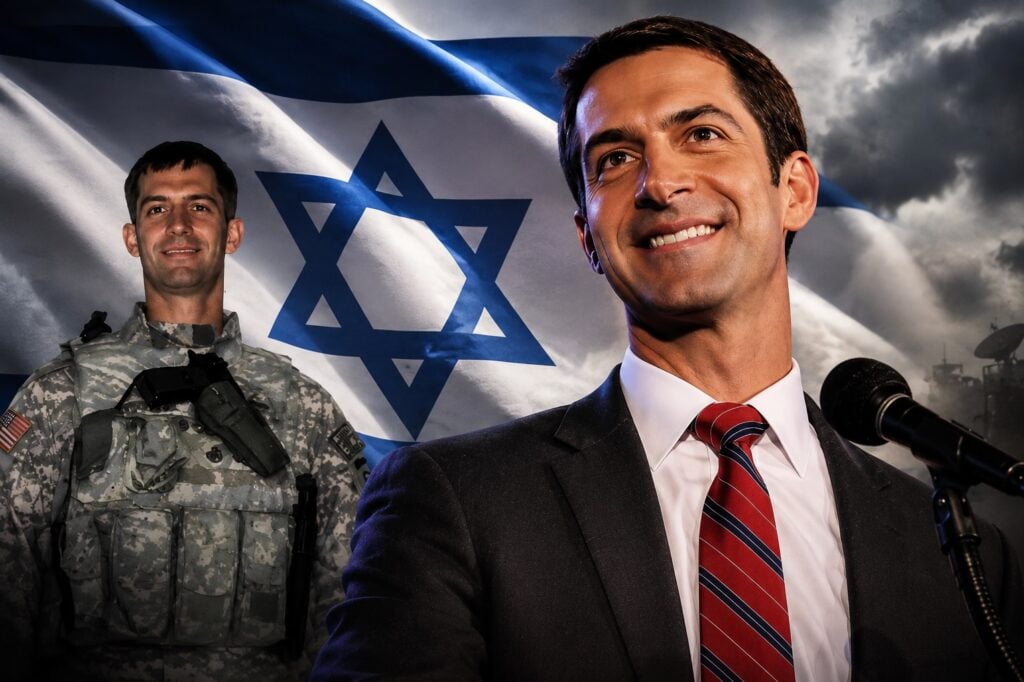
Cotton is not merely another senator weighing in on Middle East policy. He is a combat veteran who served in Iraq and Afghanistan before rising to become chairman of the Senate Intelligence Committee, giving him enormous influence over the nation’s intelligence apparatus.
A Harvard graduate who left a legal career to join the Army, Cotton deployed as an infantry officer and earned a Bronze Star, Combat Infantryman Badge, Ranger Tab, and Airborne qualification before entering politics. Few members of Congress can claim a combat résumé as substantial as his.
Military service has long carried political significance in America. Voters often assume veterans possess a deeper understanding of war, foreign commitments, and the consequences of national-security decisions.
For that reason, Cotton’s support for expanding intelligence cooperation with Israel raises questions that extend beyond the legislation itself.
The Public Message vs. The Legislative Record
Visitors to Senator Cotton’s official website are greeted with familiar themes: immigration enforcement, American sovereignty, national security, military strength, protecting American jobs, securing the border, defending American technology, and confronting foreign adversaries.
His immigration platform states that “America is a nation of laws, and a country without a border is not a country.”
His national security platform emphasizes strengthening the military, protecting U.S. technology, defending American supply chains, and countering threats from China, Russia, Iran, and terrorist organizations.
Those positions have helped establish Cotton as one of the Senate’s most recognizable advocates of an America First approach to national security.
Yet one of the least-discussed legislative initiatives associated with his tenure as chairman of the Senate Intelligence Committee is not focused on immigration, border security, China, or domestic concerns.
Instead, it focuses on strengthening and protecting intelligence-sharing arrangements with Israel.
The contrast raises a question many voters may never have been asked:
If sovereignty and America First principles are central to Cotton’s political brand, why is one of the least-publicized pieces of legislation associated with his leadership focused on deepening statutory intelligence ties with a foreign government?
Supporters would argue the answer is simple. Israel is one of America’s closest allies and most capable intelligence partners in the Middle East. Strengthening that relationship strengthens American security.
Critics see something different.
They argue that voters who support an America First agenda deserve a broader public discussion about legislation that could make future intelligence cooperation with a foreign government more difficult to reduce or reconsider.
What Makes Section 622 Different?
The United States and Israel already share intelligence.
That fact alone is not controversial. Intelligence cooperation between the two countries has existed for decades and spans counterterrorism, missile defense, cybersecurity, monitoring Iranian activities, and regional military threats.
What makes Section 622 noteworthy is not that it creates intelligence sharing.
It doesn’t.
Instead, the legislation would elevate and formalize that relationship in federal law.
Under the proposed language, the President, acting through the Director of National Intelligence and, when necessary, the Secretary of War, would be directed to expand and enhance intelligence sharing with Israel.
The legislation goes further by limiting the ability of future administrations or intelligence officials to scale back that cooperation.
Any significant reduction, suspension, or limitation of intelligence sharing would require a specific and identifiable national security concern determined by the President.
Congress would then receive notification and an explanation of the decision.
In practical terms, critics argue the provision changes the default position of the relationship.
Instead of intelligence sharing occurring at levels determined by changing strategic circumstances, future administrations would effectively begin from a presumption that cooperation should continue and expand unless the President personally intervenes to restrict it.
The bill identifies a broad range of intelligence areas for enhanced cooperation, including terrorism, cybersecurity threats, missile threats, drone threats, sanctions evasion, technology proliferation, regional military activities, and other security concerns affecting Israel, the United States, and regional partners.
Supporters view the measure as recognition of Israel’s importance as a strategic intelligence partner.
Critics view it as Congress placing a foreign intelligence relationship on a privileged statutory footing rarely seen elsewhere in U.S. law.
For some veterans, the concern is not that intelligence is shared with Israel.
The concern is whether Congress should be placing future presidents and intelligence officials in a position where reducing that cooperation becomes politically and procedurally more difficult than maintaining it.
To those critics, Section 622 appears less like an intelligence-sharing agreement and more like an effort to institutionalize a particular foreign-policy preference for future administrations.
The Timing Raises Questions
The debate surrounding Section 622 does not exist in a vacuum.
The measure arrives amid unprecedented international scrutiny of Israeli military operations in Gaza and Lebanon.
According to the United Nations’ annual Report on Children and Armed Conflict released on June 17, 2026, government forces were identified as the leading perpetrators of grave violations against children for the first time in the report’s 30-year history.
The report documented 38,558 verified grave violations affecting 24,174 children worldwide.
Among all situations monitored globally, the Occupied Palestinian Territory and Israel recorded the highest number of verified violations.
The UN attributed 7,188 verified violations to Israeli armed and security forces while also documenting violations committed by Hamas, Palestinian Islamic Jihad, Hezbollah, and other armed groups.
The report found that 6,266 children were killed and 7,958 maimed worldwide.
Israeli officials have repeatedly challenged UN reporting related to the conflict, arguing that many assessments fail to adequately account for the realities of fighting terrorist organizations embedded within civilian populations. Supporters of Israel point to Hamas and Hezbollah tactics as major contributors to civilian casualties and humanitarian suffering.
Regardless of where one stands on the conflict, the timing raises a legitimate question.
As Congress considers legislation designed to deepen intelligence cooperation and military integration with Israel, international scrutiny of Israeli military operations is simultaneously reaching levels not seen in decades.
Supporting an Ally vs. Preserving Flexibility
The debate is not whether Israel is an ally.
It is.
Nor is the debate whether intelligence sharing has value.
It clearly does.
The real question is whether Congress should be taking steps to place one particular intelligence relationship on a more permanent and protected legal foundation.
Supporters of Section 622 argue that Israel remains America’s most important intelligence partner in the Middle East. They contend that intelligence sharing helps counter Iran, Hezbollah, Hamas, and other regional threats while protecting both American and Israeli lives.
Critics argue that intelligence relationships should remain flexible and subject to changing American interests rather than being codified through legislation that makes future adjustments more difficult.
The issue becomes even more significant when viewed alongside other proposals currently moving through Congress.
Separate legislation in the National Defense Authorization Act encourages expanded cooperation between the United States and Israel in artificial intelligence, cybersecurity, autonomous systems, biotechnology, and other emerging military technologies.
Viewed together, these measures suggest a broader effort to deepen military, intelligence, and technological integration between the two countries.
Whether that represents prudent alliance management or an unnecessary surrender of future policy flexibility is where the debate begins.
A Question Many Veterans Are Asking
For many veterans, the issue is neither partisan nor ideological.
It is a question of priorities.
Americans have long elected veterans to public office because military service is often viewed as evidence of sacrifice, perspective, and a willingness to place the nation’s interests above personal ambition.
Some veteran lawmakers became advocates for intervention abroad. Others became critics of foreign entanglements. What united many of them was the expectation that American interests would remain the primary consideration.
Supporters of Cotton’s proposal argue that strengthening Israel directly serves American interests because the two nations face common adversaries and share common security concerns.
His critics are asking a different question.
When does supporting an ally stop being support for American interests and become a policy objective in itself?
Whether Section 622 reflects sound national-security policy or a departure from the America First principles many voters and veterans expect from their elected leaders is a debate Congress appears prepared to have quietly.
The American people may want to have it loudly.
© 2026 The Salty Soldier. All rights reserved.