More than a week after a training-related incident claimed the lives of a U.S. Army flight paramedic and a British Army non-commissioned officer at Erbil Air Base, Iraq, military officials have released remarkably few details about what actually occurred.
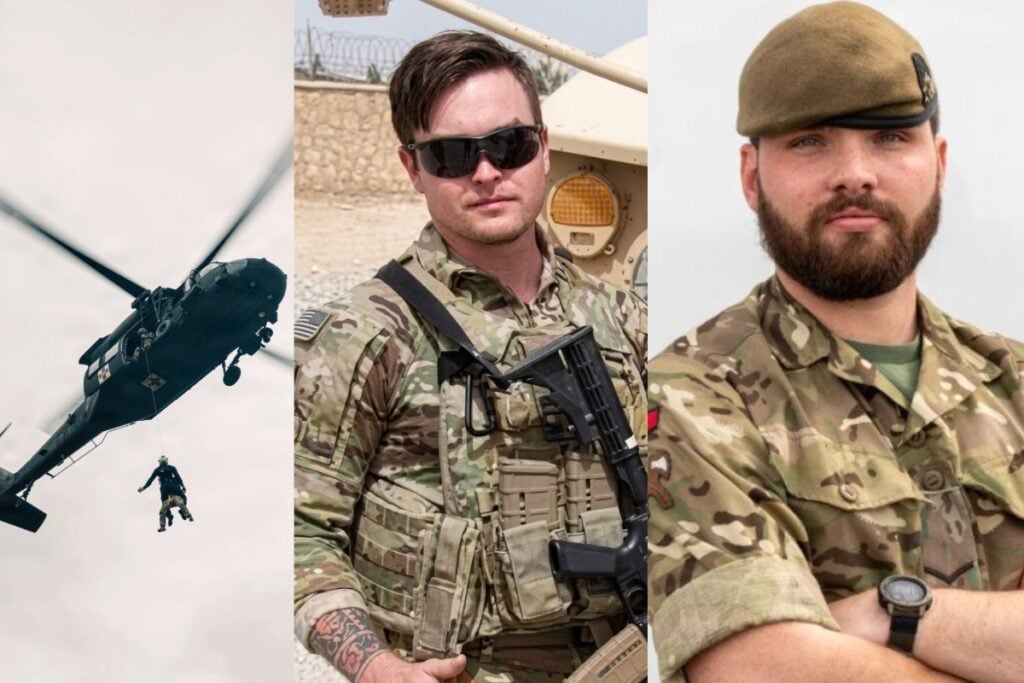
The soldiers have been identified as Sgt. Devin A. Seibel, 26, of the U.S. Army’s Air Ambulance Company, 2nd Battalion, 4th Combat Aviation Brigade, and Lance Corporal James Stewart Freeman, 29, of the British Army’s 1st Battalion, Royal Anglian Regiment (The Vikings).
Beyond confirming the deaths and stating that the incident remains under investigation, U.S. and British military officials have disclosed little about the training activity underway on May 31. Officials have not publicly stated whether aircraft, vehicles, engineering equipment, or other specialized systems were involved, nor have they explained what type of coalition training brought the two servicemembers together.
That question becomes more intriguing when examining the units involved.
Seibel served as a flight paramedic in a medical evacuation unit responsible for casualty response and patient transport operations. Freeman served as an Assault Pioneer NCO in a battalion assigned to the British Army’s Land Special Operations Force structure, a formation that has become increasingly associated with drones, robotics, autonomous systems, and next-generation battlefield technologies.
While there is currently no evidence that any of those capabilities played a role in the fatal incident, the missions of the units involved offer some of the only publicly available clues about the nature of the training event that brought the two servicemembers together in Iraq.
A Flight Paramedic and an Assault Pioneer
Seibel served as a combat medic specialist and flight paramedic assigned to an Army air ambulance company responsible for medical evacuation operations.
Army MEDEVAC units routinely train on casualty treatment, casualty extraction, patient movement, aircraft loading procedures, mass casualty response, medical evacuation planning, and integration with ground forces during both combat and training scenarios.
Freeman occupied an equally specialized role.
According to the British Ministry of Defence, he most recently served as a Section Second-in-Command within the Assault Pioneer Platoon of the 1st Battalion, Royal Anglian Regiment.
Assault Pioneers perform mobility, breaching, obstacle reduction, route clearance, field engineering, and battlefield support tasks designed to help infantry formations move and operate in contested environments. Their training can involve specialized equipment, construction tasks, mobility operations, casualty extraction drills, and engineering support missions.
The combination of a U.S. Army flight paramedic assigned to a MEDEVAC unit and a British Assault Pioneer NCO assigned to an LSOF-affiliated battalion provides one of the few public clues about the type of coalition training that may have been underway.
The British Unit’s Expanding Mission
Freeman was assigned to the 1st Battalion, Royal Anglian Regiment (The Vikings), one of three battalions within the regiment. According to the British Army, the battalion serves as part of 11 Brigade, the fighting formation of the Land Special Operations Force (LSOF), and is equipped with Robotics and Autonomous Systems.
That distinction is notable because the British Army’s public descriptions of the Royal Anglian Regiment’s other battalions focus on conventional mechanized and reserve infantry roles. The Vikings are the only battalion within the regiment specifically identified as serving within the LSOF formation equipped with Robotics and Autonomous Systems.
While military officials have not disclosed the nature of the training activity underway at Erbil Air Base, Freeman’s assignment places him within a formation that has become closely associated with the British Army’s efforts to integrate drones, autonomous systems, artificial intelligence-assisted battlefield awareness tools, and other emerging technologies into infantry operations.
Public reporting and British Army modernization initiatives have highlighted capabilities and experimentation involving tactical reconnaissance drones, First-Person View (FPV) strike drones, autonomous ground vehicles, AI-assisted target recognition systems, robotic casualty evacuation concepts, counter-drone technologies, and reconnaissance-strike capabilities designed to expand the reach and effectiveness of small infantry units.
Recent experimentation has drawn heavily on lessons learned from modern conflicts where small drones, autonomous systems, rapid battlefield adaptation, and distributed reconnaissance have fundamentally altered how military units operate. The Royal Anglians have publicly participated in exercises involving tactical drone employment, reconnaissance-strike concepts, and emerging battlefield technologies intended to provide infantry formations with greater situational awareness and operational reach.
Military officials have not stated whether any of those capabilities played a role in the fatal incident that claimed the lives of Freeman and Sgt. Devin A. Seibel. However, Freeman’s assignment to the Vikings places him within one of the British Army formations most closely associated with those capabilities, making it one of the few publicly available clues regarding the type of training environment in which the incident occurred.
What Training Was Being Conducted?
At this time, neither the U.S. Army nor the British Ministry of Defence has released details describing the activity underway when the incident occurred.
No aircraft crash has been publicly reported.
No official statements have described the event as involving aviation operations, live-fire training, demolitions, unmanned systems, engineering activities, casualty evacuation exercises, robotics platforms, or any other specific training activity.
As a result, observers are left with little more than the units involved and the missions they normally perform.
Those missions raise reasonable questions.
MEDEVAC flight paramedics are frequently integrated into complex training events involving casualty response, evacuation, extraction, and patient movement operations. Assault Pioneer units routinely participate in mobility, engineering, obstacle reduction, and battlefield support activities. Meanwhile, formations within the British Army’s 11 Brigade have been experimenting with advanced technologies intended to support reconnaissance, logistics, casualty recovery, and tactical battlefield operations.
Whether any of those capabilities were involved in the May 31 incident remains unknown.
Key Questions Remain Unanswered
No official statements from either government have indicated that drones, robotics, autonomous systems, artificial intelligence, or any other advanced capabilities played a role in the incident that claimed the lives of Seibel and Freeman.
Likewise, no public evidence currently suggests hostile action contributed to the deaths.
However, military officials have also released virtually no information beyond describing the event as a training-related incident and stating that the matter remains under investigation.
The lack of publicly available details has left unanswered questions about the nature of the exercise, the circumstances surrounding the deaths, and what brought personnel from two highly specialized military specialties together during the same training event.
The Salty Soldier submitted questions to U.S. Army Central and the British Ministry of Defence seeking additional information about the training activity, participating units, and whether aircraft, vehicles, or emerging technologies were involved in the exercise. U.S. Central Command referred questions regarding the incident to the 4th Infantry Division Public Affairs Office at Fort Carson. This article will be updated if additional information is received.
For now, the deaths of Sgt. Devin A. Seibel and Lance Corporal James Stewart Freeman remain a tragedy marked not only by loss, but by a notable lack of public information surrounding the training event that brought them together at Erbil Air Base.
© 2026 The Salty Soldier. All rights reserved.