A former Air Force pilot’s account of two majors confronting an E-4 aboard a flight carrying Condoleezza Rice is filled with explosive anger, menacing officers, and an apparently submissive airman. Somehow, it’s supposed to be a lesson in professional leadership.
Former Air Force officer and pilot Tony Carr remembers one major as a man possessing “thermonuclear anger” capable of creating a “superheated blast radius misty with vaporized piss and fear.”
The other, according to Carr, could transform from Dr. Jekyll into “Mr. Choke Yourself” in nanoseconds, leaving behind “a barely noticeable grease spot on the pavement where a hapless dweeb once stood.”
And who was on the receiving end of these two supposedly fearsome officers?
An E-4 loadmaster who apparently made the mistake of talking about the Iraq War with then-Secretary of State Condoleezza Rice.
These aren’t accusations from a disgruntled airman describing mistreatment by his superiors.
These are Carr’s own words.
In a November 12, 2026, LinkedIn article, the former Air Force pilot recounted how he and another major confronted a junior enlisted airman aboard a military aircraft in Iraq nearly two decades earlier.
Carr described the officers’ approach as “calm menace” and portrayed the encounter as a successful correction of inappropriate behavior.
And in a remarkable bit of irony, he used the experience to deliver a lengthy lecture about dignity, professionalism, and principled military leadership.
Apparently, the irony escaped him.
An E-4, Condoleezza Rice, and Two Angry Majors
In a November 12, 2026, LinkedIn article titled Stick to Talking About the NFL, Carr recounted a mission he said occurred in late 2005 or early 2006, when his Air Force crew transported then-Secretary of State Condoleezza Rice across Iraq.
Carr remembered the flight as an exceptional success.
The crew executed its mission with precision, the aircraft flew smoothly, and Rice impressed him as intelligent, approachable, and down to earth.
Everything was going beautifully.
Then an E-4 opened his mouth.
According to Carr, a junior enlisted loadmaster decided to share his personal opinions about the Iraq War and other controversial political subjects with the secretary of state.
Carr was not impressed.
He characterized the airman as surly, portrayed the conversation as an embarrassing breach of professional judgment, and described how the crew quickly found a reason to remove him from the conversation.
The airman was directed to the back of the aircraft, away from his headset, for an immediate encounter with two majors.
And Carr clearly enjoyed describing what those majors were supposedly capable of.
One possessed what he called “thermonuclear anger.” The other could apparently switch from an ordinary officer to a figure of terrifying authority in the blink of an eye.
The theatrical descriptions occupy more space in Carr’s account than any meaningful explanation of what the E-4 actually said.
Then came the confrontation.
Carr said the majors expressed their displeasure, established boundaries for future conduct, and reminded the airman of the importance of his life and future.
He characterized the officers’ approach as “calm menace.”
The E-4 reportedly raised his hands, a gesture Carr interpreted as submission and acknowledgment that the behavior would not happen again.
The officers instructed him to stick to talking about the NFL on the return trip.
Mission accomplished.
Nearly 20 years later, Carr evidently still considers this encounter memorable enough to share with the public.
The E-4’s Greatest Offense: Talking Politics?
There is a reasonable argument that the loadmaster exercised poor professional judgment.
He was serving aboard a military aircraft transporting a cabinet secretary through an active combat zone.
Carr said the crew had recently encountered a missile threat while approaching Baghdad International Airport.
His aircrew had a mission to execute, and a junior airman engaging the secretary of state in an unsolicited political debate was hardly essential to that mission.
An officer could reasonably tell the airman to stop talking politics, return his attention to his duties, and save the discussion for another time.
But Carr goes considerably further.
He uses the encounter to argue that military personnel must refrain from partisan political activity while on duty.
The problem is that Carr never tells readers what the E-4 actually said.
Was he criticizing the invasion of Iraq? Questioning the Bush administration’s strategy? Discussing the human cost of the war? Expressing support for a political party?
We don’t know.
And those distinctions matter.
The military’s 2004 directive governing political activities, which applied during the period Carr describes, permitted service members to express personal opinions on political candidates and issues, subject to restrictions.
Expressing an opinion about the Iraq War was not automatically prohibited partisan political activity.
Whether the airman violated a regulation, disrupted his duties, or merely displayed poor situational awareness cannot be determined from Carr’s account.
Yet the details Carr chooses to emphasize are telling.
We learn remarkably little about the airman’s actual statements.
We learn considerably more about the majors’ intimidating personalities and the effectiveness of their confrontation.
For an essay supposedly about professionalism, that is an interesting editorial choice.
When Rank Becomes the Point
Anyone who served in the military knows that being summoned by two majors for an immediate correction is unlikely to be an enjoyable experience for a junior enlisted airman.
The rank difference alone creates an obvious imbalance of authority.
The officers control the encounter. The subordinate is expected to listen, acknowledge the correction, and comply with lawful orders.
That may be entirely appropriate when a service member needs correcting.
But Carr’s retelling seems less interested in how the airman was professionally redirected than in how thoroughly the officers established their dominance.
His elaborate descriptions of the majors’ anger and intimidating presence are presented almost as credentials.
The airman’s raised hands become the satisfying conclusion.
The message was received.
The E-4 was put in check.
There is no evidence in Carr’s article that the majors physically assaulted the airman or subjected him to unlawful punishment. His language may have been deliberately exaggerated for entertainment.
But that’s precisely what makes the account so revealing.
Carr was not compelled to portray the incident this way.
He could have described a firm, professional correction of a junior crew member who chose an inappropriate moment to discuss politics.
Instead, he made the personalities of two intimidating majors central to the story.
And he appears to regard their approach as an example of leadership worth remembering.
The Same Officer Who Warned About Abusing Authority
Carr’s account becomes even more interesting when compared with his own previous writing about leadership.
In a January 2024 essay titled Leaving the Military: What I Learned, Carr reflected on the differences between military and civilian leadership.
Among his observations was a warning about relying too heavily on positional authority.
He described how authority-driven leadership can leave subordinates feeling powerless, discourage initiative, and create organizations where people comply because they must rather than because they believe in their leaders.
He also criticized military environments that shield senior officers from challenges and produce leaders who struggle when their authority is questioned.
Those are legitimate concerns.
They also make his story about the E-4 considerably more difficult to reconcile.
In one account, Carr recognizes the dangers of leadership built around rank and intimidation.
In another, he recounts two majors confronting a junior airman using language that appears to celebrate precisely those qualities.
It is possible Carr sees no contradiction. He may believe the correction was justified by the circumstances and that his colorful descriptions were simply military humor.
But if the purpose was to demonstrate firm, respectful leadership, why devote so much attention to how frightening the officers could be?
And why does the story seem to reach its triumphant conclusion when the E-4 raises his hands?
What If the E-4 Had Corrected the Majors?
Toward the end of his article, Carr introduces a thought experiment.
What would have happened if the roles were reversed?
Suppose an officer had behaved inappropriately in front of a junior enlisted service member. Would that airman have recognized the misconduct and possessed the courage to challenge someone with greater authority?
It’s a thoughtful question.
It’s also one that deserves to be turned back on Carr.
What if the E-4 had told the majors their approach was unnecessarily intimidating?
What if he had questioned whether their theatrical anger reflected the professionalism they were demanding from him?
Would that have been welcomed as an example of principled accountability?
Or would it have earned him another lecture about knowing his place?
Carr does not explore that possibility.
He appears satisfied that the confrontation ended with the airman displaying what Carr interpreted as contrition.
But compliance under intimidating circumstances is not necessarily proof of effective leadership.
Sometimes it simply demonstrates that a junior service member understands who holds the rank.
A Lecture About Dignity, Courtesy of the Majors
The broader target of Carr’s article was Secretary of War Pete Hegseth.
Carr argued that partisan behavior among senior military and civilian leaders has undermined the professional standards once expected throughout the armed forces.
He criticized what he considers the deterioration of dignity and consideration in military leadership, suggesting that today’s officers are increasingly unwilling to challenge inappropriate conduct from those above them.
His central argument is that standards should apply regardless of rank.
That is a defensible principle.
But Carr’s own anecdote invites a different question.
If consideration and dignity are indispensable qualities of military leadership, where exactly were they in his description of the encounter with the E-4?
The junior airman may have needed correcting.
He may have chosen an exceptionally inappropriate moment to express his opinions.
His behavior may have warranted professional counseling or more formal corrective action, depending on what actually occurred.
None of that required Carr, nearly two decades later, to transform the story into an elaborate portrait of two majors whose capacity for anger and intimidation was seemingly something to admire.
Carr presents the incident as evidence of a time when military leaders had the courage to uphold standards.
For enlisted veterans who remember being on the receiving end of similar performances, the story may evoke a very different kind of nostalgia.
Not for principled leadership.
But for a military culture in which some officers appeared to confuse being feared with being respected.
The Missing Voice
The E-4 remains anonymous.
Carr says he cannot recall the loadmaster’s name and would not identify him even if he could.
The airman’s actual words are unknown, as is his perspective on the confrontation.
There is no independent account establishing exactly what Rice heard, how the majors behaved, or how the loadmaster experienced the encounter.
Official State Department travel records place Rice in Iraq in November 2005, consistent with Carr’s approximate timeline, but those records do not independently corroborate his account of the aircrew confrontation.
What remains is Carr’s own version of events.
And that version is revealing enough.
The Photograph Carr Chose to Publish
There is one more curious detail about Carr’s decision to revisit the incident.
He says he cannot remember the E-4’s name and wouldn’t reveal it even if he could.
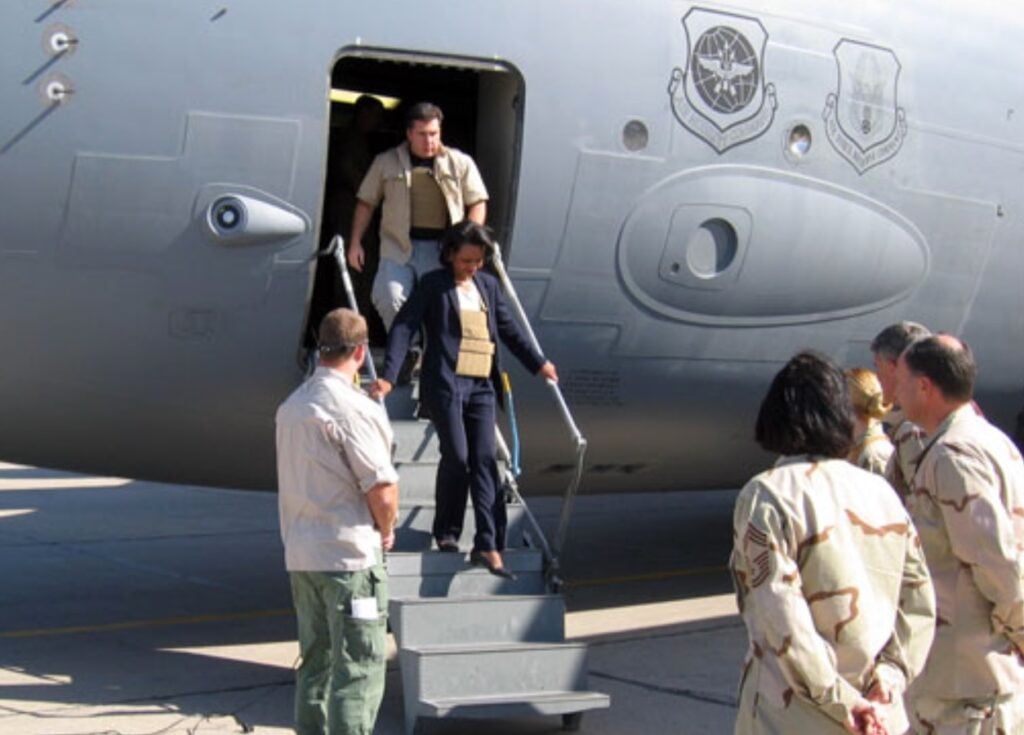
Yet Carr accompanied his story with a photograph of Condoleezza Rice standing alongside six uniformed airmen, apparently from the period of the mission he describes.
Is the unfortunate loadmaster among them?
Carr doesn’t say.
He does remark that LinkedIn’s publishing tool cropped the photograph, indicating that the awkward framing was not his intention.
But the photograph still shows several recognizable faces.
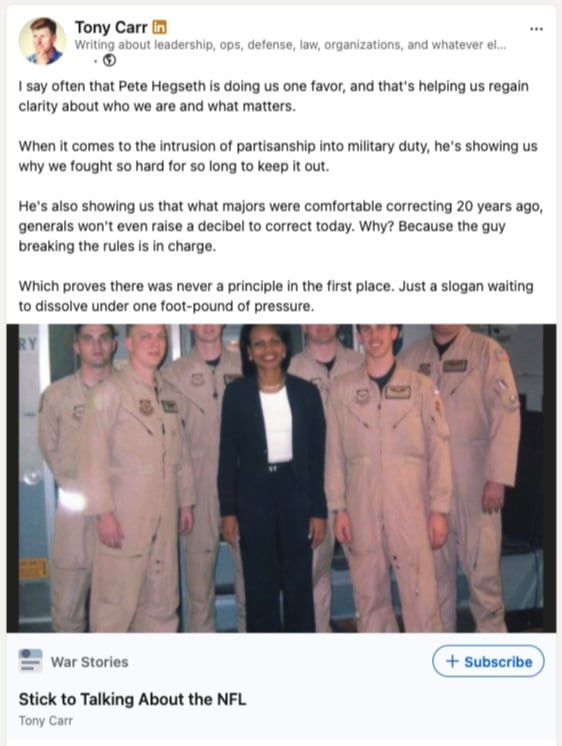
If the E-4 is among the men pictured, withholding his name may offer considerably less anonymity than Carr seems to suggest. Former colleagues and others familiar with the crew could potentially recognize him.
It is not possible to establish from the photograph alone whether the loadmaster is pictured, and there is no reason to subject the unidentified airman to unwanted public scrutiny over a nearly 20-year-old encounter.
Nevertheless, the decision to include the photograph is striking.
Carr goes out of his way to explain that he would protect the loadmaster’s identity, even while publicly describing the airman’s supposed misconduct and the intimidating confrontation that followed.
Then he publishes a group photograph associated with the very mission he is discussing.
It’s a peculiar choice for someone who professes an unwillingness to identify the junior airman while recounting, in extraordinary detail, how two majors put him in his place.
Carr might not remember the E-4’s name.
But someone looking at that photograph might.
The Leadership Lesson Carr May Have Missed
A former Air Force officer chose to publicly revisit a confrontation in which two majors exercised their authority over an E-4.
He described their intimidating personalities in extraordinary detail, portrayed the junior airman’s submissive response as a successful outcome, and used the experience to lecture readers about the importance of professionalism and dignity.
Perhaps the airman deserved correction.
Perhaps the majors were entirely justified in ending his conversation with Rice.
But the real question is why Carr apparently believes the most memorable part of the experience was the intimidating manner in which they did it.
An airman can be wrong without deserving humiliation. An officer can enforce standards without making intimidation part of the performance. And a leader can correct a subordinate without turning the experience into a war story about how thoroughly he put an E-4 in check.
Carr’s central argument is that military leaders must possess the courage to uphold standards, even when doing so means challenging someone more powerful.
That principle is difficult to dispute.
But genuine leadership requires more than the courage to confront those above you. It also requires the discipline to treat those below you with professionalism, particularly when they make mistakes.
If the E-4’s mistake was failing to recognize when to keep his mouth shut, Carr’s mistake may have been opening his nearly 20 years later.
© 2026 The Salty Soldier. All rights reserved. Reproduction without written consent is strictly prohibited.