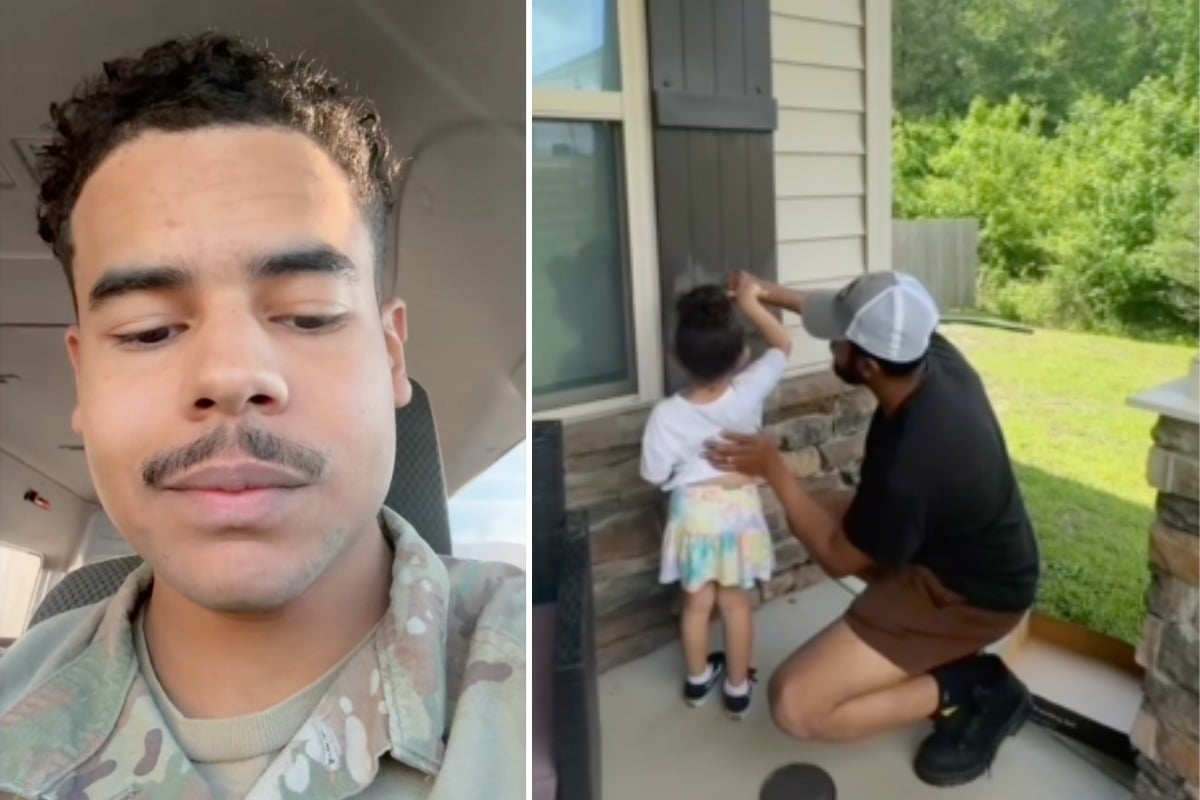
Staff Sgt. Michael Emmanuel Swinton’s funeral was held Saturday, just 20 days after he died during a military operation in Iraq. But one photograph of his young daughter looking at an image of her father holding her captures something the ceremonies and headlines cannot.
HOPE MILLS, N.C. — Two days ago, the family of Staff Sgt. Michael Emmanuel Swinton gathered for his funeral.
The service was held Saturday, Aug. 8, in Hope Mills, North Carolina, 20 days after the 30-year-old Fort Bragg Soldier died while serving in Iraq.
Swinton died July 19 at Erbil Air Base during the controlled demolition of a downed Iranian one-way unmanned aerial system, according to the Department of War. He was assigned to D Battery, 2nd Battalion, 55th Air Defense Artillery Regiment, 108th Air Defense Artillery Brigade at Fort Bragg.
His remains returned to Fayetteville from Dover Air Force Base on Aug. 3. Television cameras documented his flag-draped casket arriving at Fayetteville Regional Airport as his family waited for him. CBS 17 captured Swinton’s wife, Mia Gonzalez-Swinton, leaning over her husband’s casket as family members gathered around her.
Five days later, his funeral was held.
The funeral made the news. There were grieving relatives, fellow Soldiers and the public rituals that accompany the return and final farewell of a service member who died thousands of miles from home.
But funerals eventually end. The television crews leave. The motorcade disappears down the road. The carefully folded flag is carried home.
And a family is left to live with what happened.
Today is Aug. 10. Only 22 days have passed since Swinton died, and only two days have passed since his funeral. For the public, the ceremonies surrounding his death are coming to an end. For those who loved him, the absence is only beginning.
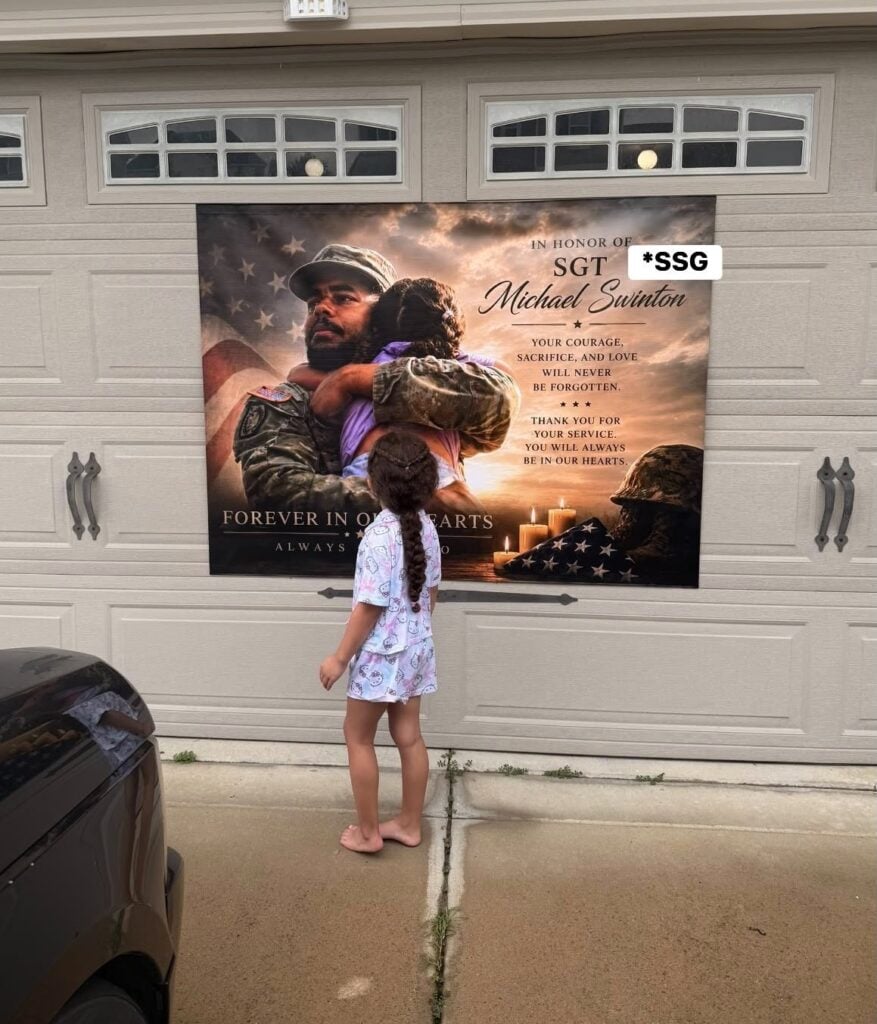
Perhaps no image captures that reality more powerfully than a photograph shared by Gonzalez-Swinton.
In it, their young daughter, Alëía, stands outside the family home looking up at a memorial banner for her father. Among the photographs displayed on it is one of Swinton holding Alëía in his arms.
Now she stands before that photograph without him.
There are no military formations in the image, no ceremonial rifles and no television microphones.
Just a little girl looking at her dad.
It may convey more about the gravity of Swinton’s death than any account of his funeral ever could.
Swinton was more than the rank appearing before his name. Before he was Staff Sergeant Swinton, he was Michael — a husband, father, son, brother, uncle and friend.
And to his children, nearly nine years of Army service, deployments and military accomplishments could never outweigh the title that mattered at home:
Dad.
Michael Emmanuel Swinton was born June 30, 1996, in Fayetteville, North Carolina, to Christel Swinton and Willie Shaun McMillian. During his childhood, he lived in North Carolina, New York, Alabama and Utah, experiences his obituary says helped shape the resilient and compassionate man he would become.
He grew up as a big brother who remained deeply connected to his siblings and family. Those close to him remembered his intelligence, adventurous spirit and ability to form lasting friendships wherever life took him.
Inspired by relatives and close friends who had served before him, Swinton enlisted in the Army in 2017. He completed Basic Combat Training at Fort Jackson, South Carolina, beginning a military career that would span nearly nine years.
His assignments included Fort Hood, Texas, and Fort Bragg, North Carolina, while his service also took him overseas to Kuwait, Bahrain and Iraq.
While stationed at Fort Hood, Swinton became a father. His son, Geremy Michael Swinton, was born in March 2020.
Later, while serving in Bahrain, Swinton met Mia “Mimi” Gonzalez. What began as a friendship grew into a relationship built around the two sharing their lives despite the demands of military service. They married Sept. 30, 2021.
Their family later grew with the birth of their daughter, Alëía L. Gonzalez-Swinton.
For a man whose career required deployments, separations and long periods away from home, his obituary makes clear that fatherhood became the role he treasured most. Swinton read bedtime stories, played games with his children, shared laughs with them and tried to make the time they had together count.
Those moments rarely appear in military biographies. They are not reflected by rank, qualification badges or award citations, but they are often the moments that matter most once a uniformed parent walks through the front door.
The photographs shared by Swinton’s family show that side of him repeatedly. There is Michael the Soldier, but there is also Michael holding his children, spending time with his wife and living the ordinary parts of family life that existed around an extraordinary profession.
In 2025, Swinton returned to Fort Bragg before deploying once again to Iraq.
On July 19, that deployment became his last.
Military officials said Swinton was killed during the controlled demolition of a downed Iranian one-way drone at Erbil Air Base.
His death immediately became a military casualty, something that necessarily brings with it official notifications, the transfer of remains, casualty assistance and ultimately ceremonies intended to honor a fallen Soldier.
Those traditions matter.
America has developed them because there are moments when words are inadequate. A flag covering a casket, Soldiers standing at attention and a folded flag presented to a grieving family carry meanings developed over generations of military service and sacrifice.
But those traditions cannot replace the person beneath the flag.
For Swinton’s family, the significance of July 19 cannot be measured only by what happened that day in Iraq. His children will continue growing older. There will be birthdays, holidays, school events, graduations and countless ordinary moments in which their father’s absence may be felt.
Mia must continue forward without the husband with whom she expected to experience those moments.
That is the part of military loss that often exists beyond the headline.
For the public, the death of a service member can eventually become a name, date, location and description of an incident. For the people who loved that person, the date becomes something entirely different — a dividing line between the life they knew and the life they must somehow continue living.
For the Swinton family, that line is July 19, 2026.
The response to Gonzalez-Swinton’s public posts offers a glimpse of the community trying to surround the family in the days since.
Friends, military spouses, veterans and strangers have left messages of condolence and support. Some offered more than words, volunteering to bring meals, clean the family’s home, babysit or simply be there for a grieving military spouse.
One man who said he knew Swinton from his time in the service remembered him as “one of the coolest dudes” he had met and “an even better soldier.”
Another left the familiar military farewell: “Till Valhalla my brother!”
A woman at Fort Bragg offered to bring meals, clean the house or babysit. Another commenter whose spouse was deployed in the same area told Gonzalez-Swinton that she had followed the family’s heartbreak and could not fathom the pain she was experiencing.
Those messages are reminders that military casualties ripple outward.
The Army lost a staff sergeant. His unit lost a Soldier and leader. Friends lost someone who had served beside them.
Inside his family, the loss is more personal.
A wife lost her husband.
His children lost their father.
Swinton’s obituary says that above every title he held, the ones he treasured most were husband and father. The photographs left behind show why.
There he is smiling with his family. There he is holding his children. There are embraces, ordinary moments and memories that probably seemed unremarkable when the pictures were taken because no one taking them knew how precious they would eventually become.
And then there is the photograph of Alëía.
She stands outside the home facing the memorial for her father. In front of her is an image from another time — Michael alive, with her in his arms.
The contrast needs little explanation.
The photograph on the memorial preserves a moment when a father could hold his daughter.
The child standing before it is now learning what it means for him to be gone.
On Aug. 3, cameras documented Swinton’s return home.
On Aug. 8, his family gathered for his funeral.
Today is Aug. 10.
Tomorrow will be Aug. 11.
The dates will continue moving forward. News coverage will turn toward the next story, as it always does. The ceremonies will end, flowers will eventually disappear and the public attention surrounding Swinton’s death will diminish.
His absence will not.
His fellow Soldiers will remember Staff Sgt. Michael Emmanuel Swinton and the man who served beside them. The Army will remember a Soldier who gave nearly nine years of his life to the service and died while deployed overseas.
His children will carry something different.
They will remember the man in the family photographs, the voice behind the bedtime stories, the father who played with them, laughed with them and held them in his arms.
And for Alëía, one of those moments now exists on a memorial she can stand in front of and see.
To the country, Michael Swinton was a fallen American Soldier.
To his children, he was something far more important.
Dad.
© 2026 The Salty Soldier. All rights reserved. Reproduction without written consent is strictly prohibited.