A former Army-affiliated employee accused of leaking classified information about one of the military’s most secretive units had already lost access to classified systems years before the alleged disclosures, according to a federal affidavit filed in North Carolina.
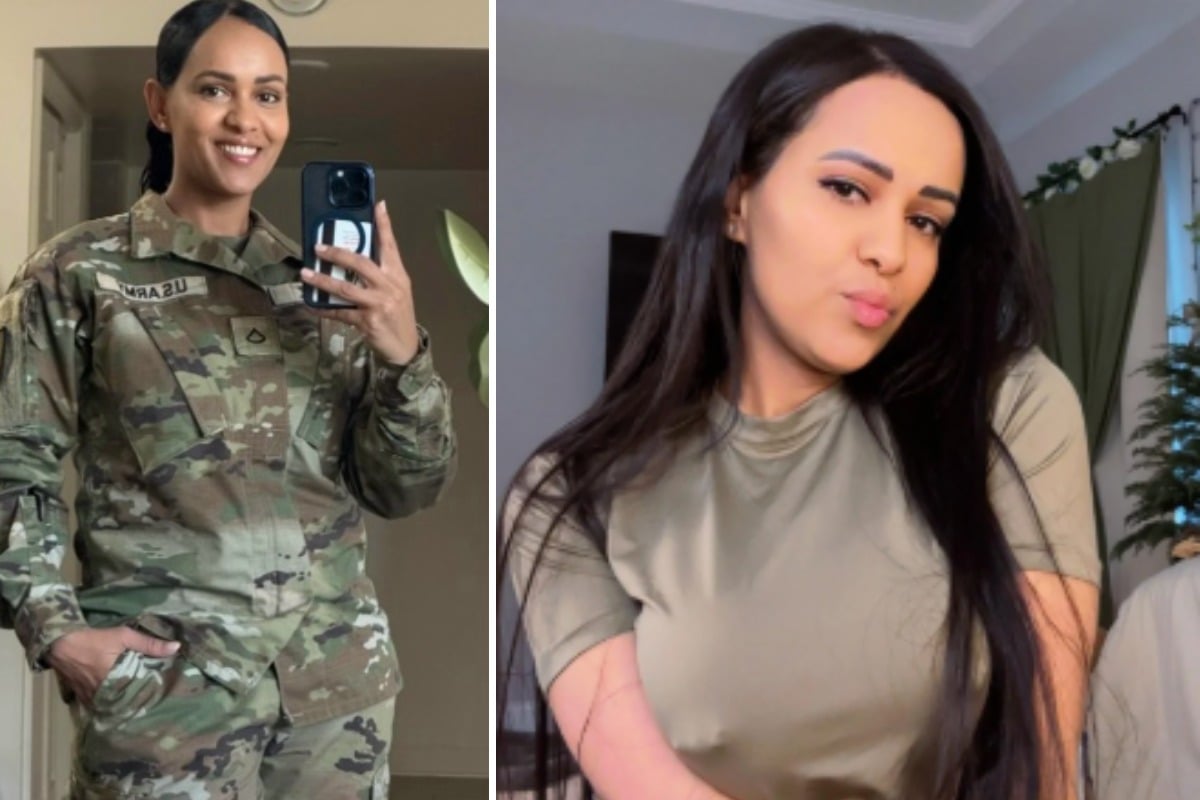
Courtney P. Williams, 40, is charged with unlawfully communicating national defense information after prosecutors say she shared sensitive material about a Fort Bragg-based Special Military Unit (SMU) with an individual not authorized to receive it.
Williams held a Top Secret security clearance from 2010 to 2016, giving her access to classified national defense information.
According to the affidavit, that access was suspended around 2015–2016 following an internal investigation, and she was reassigned to duties that did not require access to classified systems.
Prosecutors state that from 2022 through 2025, Williams communicated with a journalist who was preparing both an article and a book concerning a U.S. special operations unit. The affidavit does not identify the journalist, publication, or unit by name.
Separate public reporting has identified the journalist’s 2025 book as The Fort Bragg Cartel: Drug Trafficking and Murder in the Special Forces and an accompanying Politico Magazine article describing Williams’ experiences working within a Fort Bragg-based special mission unit. That reporting characterizes the unit as Delta Force, the Army’s highly secretive commando element operating under Joint Special Operations Command, and names Williams as a source.
According to the publisher’s description of the book, the reporting extends beyond internal workplace complaints and into allegations of serious criminal activity tied to the special operations community at Fort Bragg. The book centers in part on the 2020 killing of two individuals, including a Delta Force soldier who, according to the publisher, “was addicted to crack cocaine, dealt drugs on base, and had committed a series of violent crimes before he was mysteriously killed.”
According to the affidavit, those communications included more than 180 messages and extended phone calls over several years, totaling more than 10 hours. Investigators state that Williams provided photographs, documents, and written materials containing classified national defense information during that time.
Investigators describe what they characterize as sustained activity rather than a single disclosure. Documents recovered from Williams’ devices were reportedly organized into files labeled for transfer, including “Batch 1 for Reporter” and “Batch 2 for Reporter,” with at least ten such groupings identified.
A 2025 Politico Magazine article adapted from Harp’s book, The Fort Bragg Cartel: Drug Trafficking and Murder in the Special Forces, provides additional context about the scope of his investigation. In that piece, Seth Harp—an Iraq War veteran and investigative reporter—wrote that his inquiry began with the 2020 double homicide at Fort Bragg and expanded into what he described as a broader pattern of unexplained deaths, drug activity, and misconduct within elements of the special operations community.
The article draws on interviews and reporting to describe what is portrayed as a culture shaped by years of sustained combat operations and limited oversight within elite units.
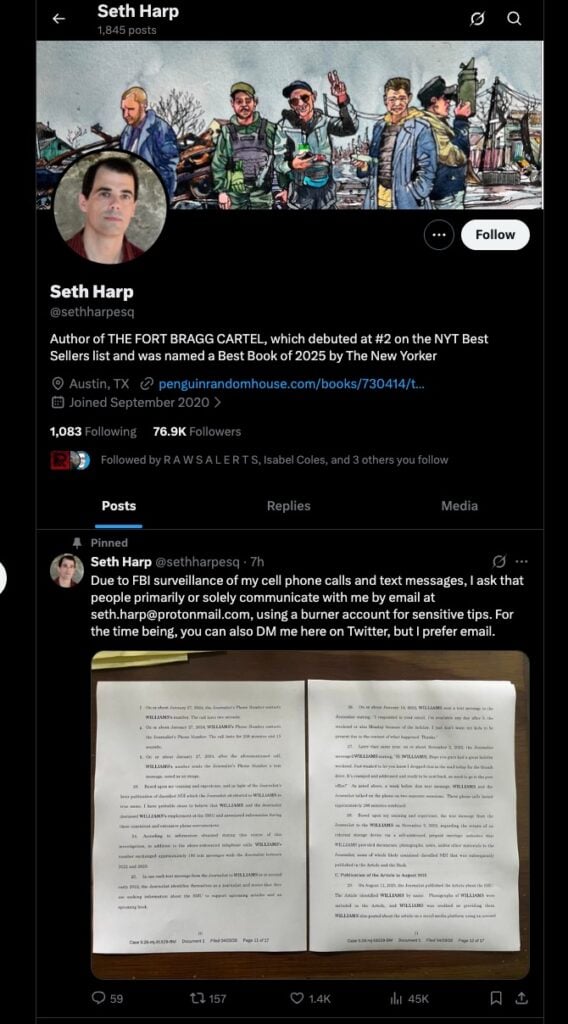
In a recent development, Harp indicated that his work may now be drawing additional scrutiny. In a post to his X (formerly Twitter) account on April 10, he stated that he believes his communications are being monitored by federal authorities, writing that due to what he described as FBI surveillance of his phone calls and text messages, he is asking sources to communicate with him through email or burner accounts. The post included images of printed pages from what appear to be court documents related to the case. That claim has not been independently verified.
Those descriptions and statements are drawn from the journalist’s reporting, the publisher’s materials, and public comments, and are not allegations contained in the criminal complaint.
The affidavit states that the material Williams allegedly provided included classified tactics, techniques, and procedures, commonly referred to as TTPs—the operational methods used by military units to plan and execute missions. Within special operations units, TTPs are among the most closely guarded forms of information because they directly shape how missions are carried out in real-world environments.
According to the affidavit, unauthorized disclosure of such information could expose U.S. personnel to identification, detention in hostile nations, bodily harm, or death.
The affidavit also includes statements attributed to Williams that investigators say reflect awareness of the risks associated with disclosing classified information. In messages cited in the complaint, Williams told her mother she “might actually get arrested,” adding that it would be “for disclosing classified information.”
In another statement referenced in the affidavit, she acknowledged that the risks of disclosure had been emphasized throughout her career, stating in substance that she had “known [her] entire career” the consequences and that “they tell you” within the unit.
The affidavit further states that Williams continued communicating with the journalist after publication of the article and book identified in public reporting and expressed concern about “the amount of classified information being disclosed.”
While the charges focus on the alleged transmission of classified information years later, the affidavit’s reference to a prior suspension of Williams’ access to classified systems introduces an additional element to the timeline. According to the filing, her access was revoked following an internal investigation during her time supporting the SMU, and she was reassigned before ultimately leaving the unit.
She later underwent a formal security debriefing acknowledging her obligation to protect classified information even after leaving government service.
Williams has been charged under a provision of the Espionage Act that criminalizes the unauthorized transmission of national defense information to individuals not entitled to receive it.
The case remains at the criminal complaint stage in federal court in the Eastern District of North Carolina, and prosecutors must still seek a formal indictment to proceed.
As the case moves forward, the central legal question will be whether Williams knowingly transmitted closely held national defense information. The affidavit also reflects that those risks were not abstract—they were repeatedly emphasized during her time working in classified environments.
© 2026 The Salty Soldier. All rights reserved. Reproduction without written consent is strictly prohibited.