An online account claiming to belong to a 19-year-old U.S. Army Private First Class is drawing attention after posting explicit content tied directly to military identity, rank structure, and barracks life.
The account presents itself as an active-duty soldier and openly references a fixation on verbal degradation tied to authority figures within the chain of command. The content is self-produced and repeatedly connects sexual behavior with military hierarchy, discipline, and leadership dynamics.
This version of the story has been formatted for a general audience, with certain content witheld, blurred, or cropped. The full uncensored version is available at The Salty Soldier Uncensored—nothing removed.
In at least one post, the individual acknowledges awareness of potential violations, stating she may be “breaking opsec” by posting images in uniform. That admission alone raises questions about judgment, awareness, and intent.
The activity is not isolated. The content has been widely circulated across multiple online communities, significantly increasing visibility and the likelihood of identification.
Equally notable is the environment surrounding the content.
Comment sections show a pattern of participation from other users who adopt the tone and authority of senior leaders, directing degrading and command-style language at the account. The interaction reflects a broader trend in which military structure and authority are repurposed into explicit roleplay dynamics.
Some participants present themselves as current or former service members. Whether those claims are legitimate or not, the behavior demonstrates how military identity is being used as a framework for power-based degradation in public online spaces.
Not all responses were supportive. Several individuals warned the account about the risk of exposure and potential consequences. The response was dismissive, with the individual expressing confidence that she would not be identified due to the size of the military population. Others pointed out the flaw in that reasoning—while the force is large, identity is not anonymous when a face is involved.
That exchange highlights a critical element: the risk was understood and deliberately ignored.
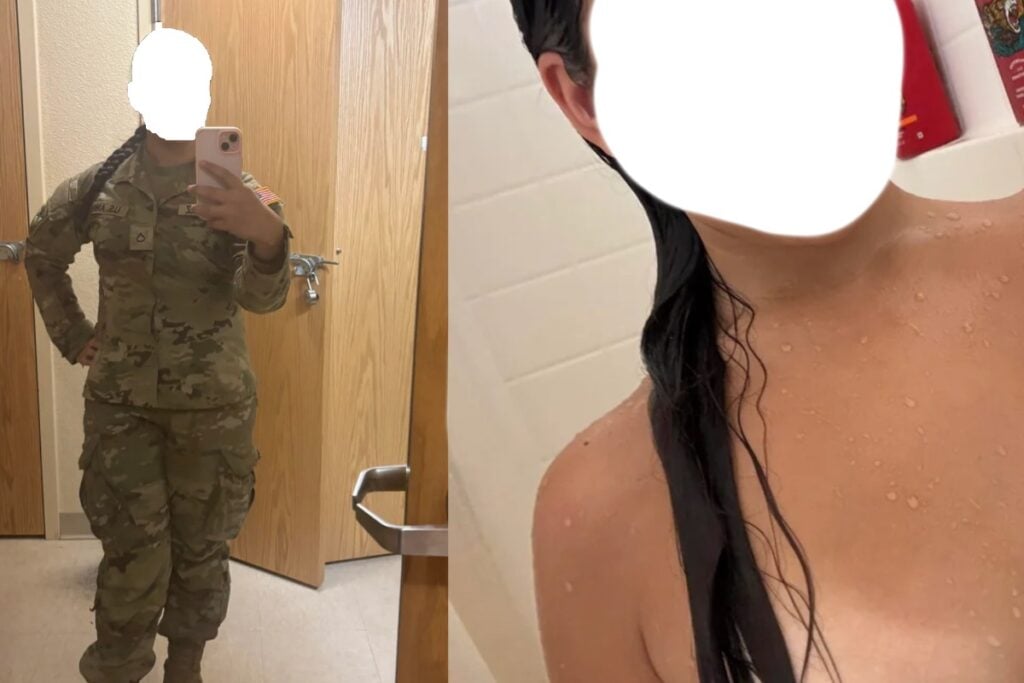
Images associated with the account further raise concern. Multiple photos appear to show the same individual both in uniform and in explicit content, taken in what appears to be the same barracks-style room and bathroom environment.
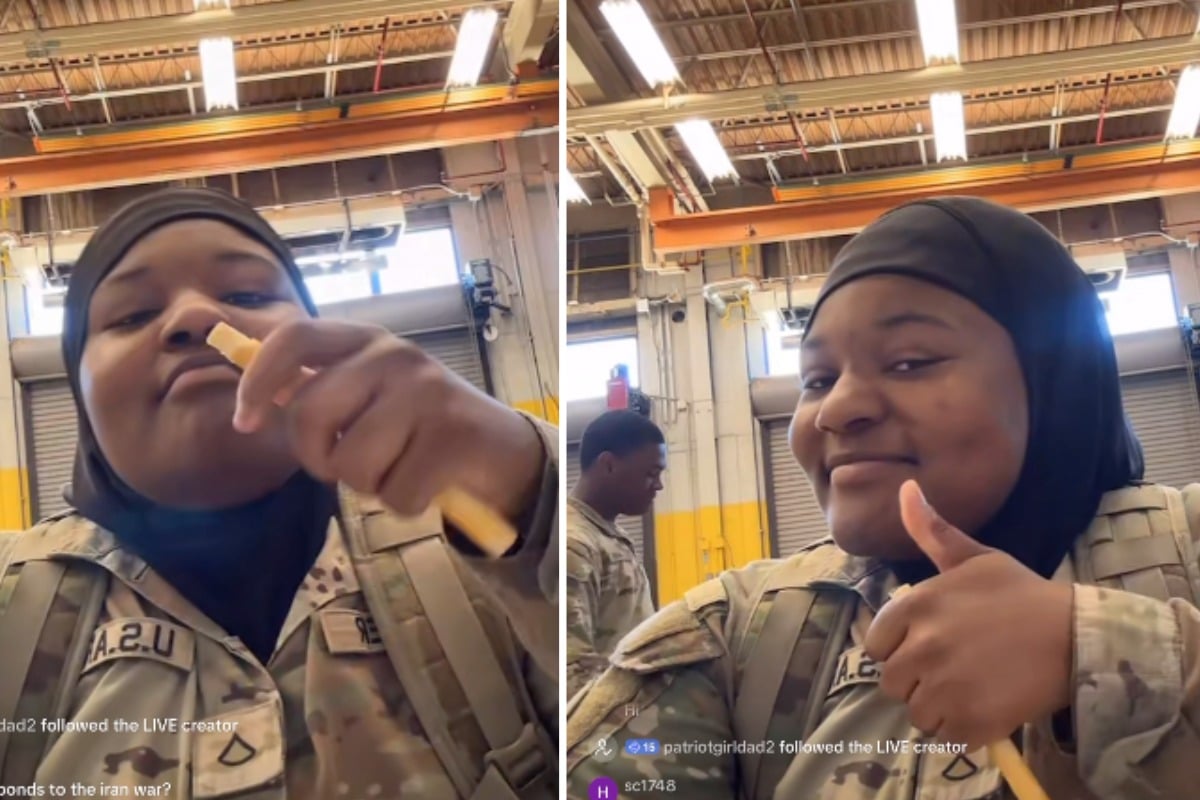
In uniform, the individual is seen wearing standard camouflage with a visible U.S. flag patch and military gear. In at least one image, she appears to be wearing a U.S. Army Training and Doctrine Command (TRADOC) shoulder patch, which is commonly associated with training environments such as Basic Combat Training and Advanced Individual Training.
Additional images show the individual wearing a lanyard-mounted badge featuring a large “V,” which is consistent with phase-based privilege systems used in Advanced Individual Training (AIT). In these environments, soldiers are required to carry visible phase badges that reflect their level of progression and authorized privileges.
The prominent “V” marking is commonly associated with Phase V, a stage in AIT where soldiers have moved beyond initial restrictions and are granted increased autonomy, including access to personal electronics and greater freedom of movement within—and in some cases outside—the installation.
While phase badge formats can vary by unit, the structure and presentation of the badge closely align with known AIT phase identification systems, reinforcing the likelihood that the individual is in a later stage of initial entry training.
The presence of personal electronics—including a tablet visible inside the barracks room—further separates this from Basic Combat Training, where such items are typically restricted.
Taken together, the indicators strongly point toward an Advanced Individual Training environment.
If accurate, that places this behavior inside a controlled training pipeline—not a permanent unit—and raises immediate questions about supervision, discipline, and command awareness.
If the individual is in fact an active-duty soldier, the implications are straightforward.
Under the Uniform Code of Military Justice, service members can be held accountable for conduct that brings discredit upon the armed forces or undermines good order and discipline. The use of military identity, uniform imagery, and rank structure in explicit content tied to degradation and authority dynamics may fall within that scope.
Uniform regulations also restrict the use of the uniform in contexts that bring discredit to the service. Posting explicit content in uniform or within a military living environment may constitute a violation.
The OPSEC angle adds another layer. Even without classified information, identifiable living spaces, layouts, and personal features increase the risk of exposure.
Beyond the individual case, the larger issue is harder to ignore.
This is not just one account posting explicit content. It reflects a broader trend in which military identity, rank structure, and authority are being pulled into online spaces and reshaped into something else entirely—blurring the line between personal behavior and professional standards.
And it is happening in public, with participation from others willing to engage in the same dynamic.
At this stage, key facts remain unconfirmed. The identity of the individual is not verified, and it remains possible the account is misrepresenting itself.
But the pattern is clear.
Military imagery.
Rank-based dynamics.
Barracks environment.
Training command indicators.
All converging in one place.
At some point, this stops being about what is posted—and becomes about what happens next.
Because once something like this spreads beyond its original audience, there are only two outcomes:
It gets ignored.
Or it gets found.
And when it does—
it won’t be the internet that handles it.
© 2026 The Salty Soldier. All rights reserved. Reproduction without written consent is strictly prohibited.