Richard Tillman, the younger brother of late NFL star and Army Ranger Pat Tillman, is facing the possibility of decades in federal prison after admitting he intentionally rammed a vehicle into a U.S. Post Office in California and set it on fire — an incident prosecutors say he carried out to “make a point to the United States government.”
Federal prosecutors in the Northern District of California said Tillman, 44, pleaded guilty to malicious destruction of government property by fire stemming from the July 20, 2025 attack on the Almaden Valley Post Office in San Jose. Sentencing is scheduled for April 27, 2026 and prosecutors say the charge carries a mandatory minimum of five years and a maximum of 20 years in prison.
In its announcement, the U.S. Attorney’s Office described a deliberate sequence: Tillman purchased firelogs and lighter fluid, drove to the post office, backed his vehicle through the front entrance, spread accelerant, and ignited the vehicle — with the fire spreading into the building and destroying the lobby.
Court filings and reporting on the case also say Tillman livestreamed the incident on YouTube, and admitted to tagging the building with the unfinished phrase “Viva La Me.” Postal Inspector Shannon Roark wrote that Tillman “did not finish what he wanted to write because the heat … was too intense.”
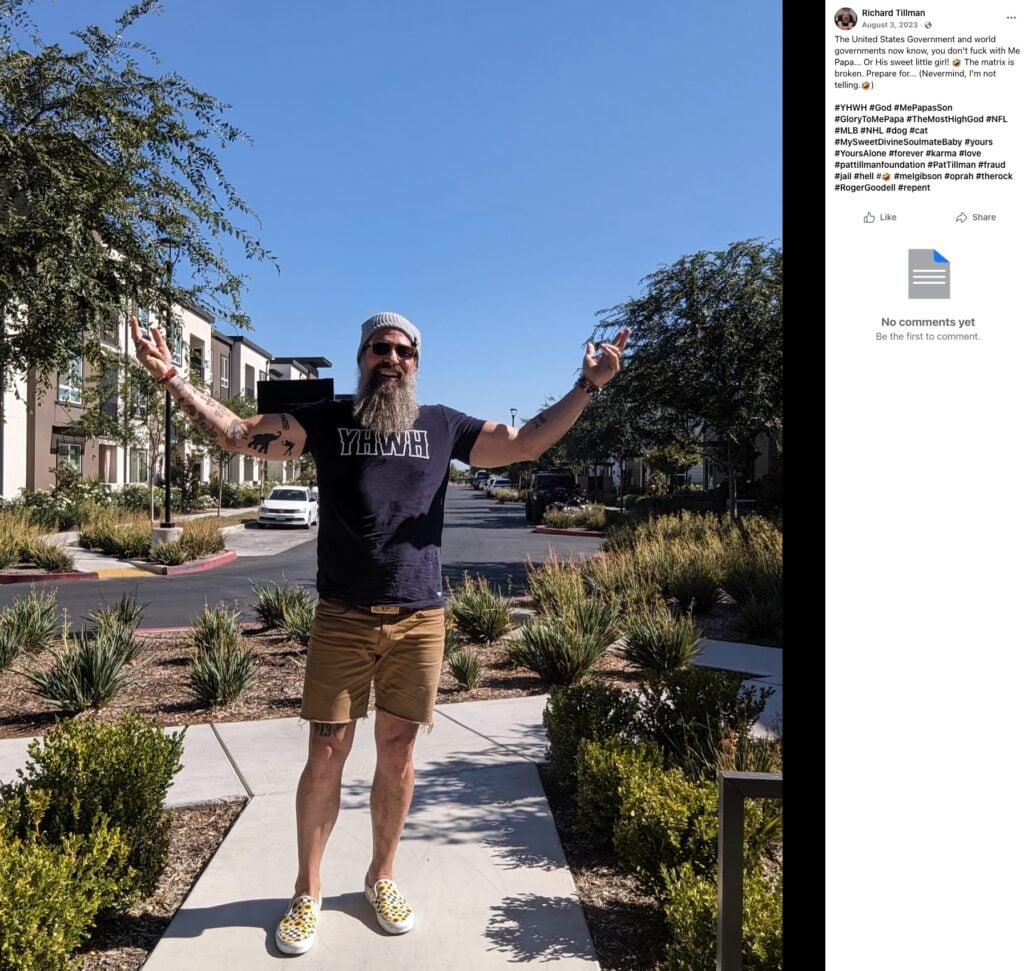
While his YouTube channel and its content have since been removed, publicly available social media posts reviewed by The Salty Soldier show repeated references to “Me Papa,” “Yeshua HaMashiach,” and statements in which Tillman appeared to identify himself as a divine figure, suggesting the unfinished graffiti may have been self-referential rather than tied to any known political organization.
No one was physically injured during the fire, according to authorities and published reporting.
Reporting on the plea notes the Tillman family has said Richard Tillman has battled severe mental health issues for years, and that he has previously described being homeless. Those claims have not been adjudicated as a defense to the charge; they have been presented publicly as family context around his condition.
The shadow of Pat Tillman’s death — and why “closure” never came
The case has renewed attention around the Tillman family’s long and public rupture with the military narrative surrounding Pat Tillman’s death in Afghanistan in 2004 — a death that, for many Americans, became a symbol before the truth was widely acknowledged.
In the immediate aftermath of the April 22, 2004 firefight in southeastern Afghanistan, the Army initially portrayed Tillman’s death as the result of enemy fire. It would take weeks before the Pentagon publicly acknowledged that he had been killed by fellow Rangers in a friendly-fire incident.
An extensive investigative series published by ESPN.com in 2006 detailed that Pat Tillman was killed during a close-range friendly-fire engagement and was struck by three rounds to the forehead. According to that reporting, the grouping of the wounds was so tight that medical examiners questioned whether the official battlefield narrative fully aligned with the physical evidence. The ESPN investigation underscored a point that still gnaws at the story: multiple Army inquiries did not publicly identify the person who fired the fatal shots.
Lt. Col. Ralph Kauzlarich, the Ranger Regiment executive officer who directed the Army’s first official inquiry into Tillman’s death, told ESPN that ballistics work was conducted and suggested the Army may have known more internally than it ever disclosed publicly.
“I think, yeah, they did. And I think they know [who fired]. But I never found out,” Kauzlarich said.
Kauzlarich also argued he wasn’t personally driven to pin the death on a single shooter, framing the incident as a broader, chaotic fratricide event rather than one man’s isolated act.
“You know what? I don’t think it really matters,” Kauzlarich told ESPN. “Somebody hit him. So would you hold that guy responsible for hitting him, when everybody was shooting in that direction, given the situation?”
That posture — “we may never know,” and even if we did, would it matter — collided with a family that believed the institution had already failed the first duty it owed: the truth.
Further complicating the record were revelations that potentially key physical evidence was destroyed within days of the incident. According to congressional testimony and investigative reporting, Tillman’s body armor and uniform were burned shortly after his death. A small notebook he carried was also destroyed. Soldiers later described the items as blood-soaked and unsanitary, but critics argued that the destruction eliminated material that could have clarified ballistic trajectories and sequence of fire.
Additional reporting, including accounts based on Army investigative materials, cited military medical examiners who questioned whether the wound pattern matched the evolving battlefield description. One examiner told investigators that the medical evidence “did not match up with the scenario as described,” noting the extremely tight grouping of the fatal head wounds. Some doctors reportedly suggested the spacing of the rounds was consistent with shots fired from relatively close range.
At the same time, Army investigations concluded the death was accidental friendly fire, and a later review stated there was no evidence of an intentional cover-up, attributing delays and misinformation to confusion and miscommunication in a combat environment. Yet even that conclusion acknowledged that senior officials were aware of the likelihood of fratricide well before the Tillman family was informed.
Adding another layer of complexity, Kevin Tillman — Pat’s brother and fellow Ranger — was present in the same platoon during the firefight. The unit had been split into two elements while towing a disabled Humvee through mountainous terrain. Pat was with the lead element on the ridgeline; Kevin was in the trailing convoy that came under fire in the canyon below. Witnesses later described Kevin learning of his brother’s death from another Ranger in the darkness after the shooting stopped.
Over the years, multiple investigations were conducted under Army Regulation 15-6 and later by the Defense Department Inspector General. While disciplinary actions were taken against several soldiers, no criminal charges were filed in connection with the shooting itself. The Silver Star awarded to Tillman was upheld despite internal knowledge that friendly fire was suspected at the time the citation was drafted.
For many Americans, Pat Tillman became a symbol of post-9/11 patriotism — the NFL player who walked away from a multimillion-dollar contract to serve. But the layers of delayed disclosure, destroyed evidence, unanswered ballistic questions, and internal debate over what commanders knew — and when — ensured that the story never settled into a simple narrative.
The firefight ended in 2004. The questions surrounding it did not.
Pat Tillman wasn’t a political prop — and his own views complicate the mythology
In the years after Pat Tillman’s death, his image was routinely pulled into America’s culture wars. His widow, Marie Tillman, has repeatedly warned against that reflex. “Pat was always known as a free thinker who was constantly growing,” she wrote, adding that it’s a mistake to “freeze him in time.”
She also rejected the idea that patriotism is blind obedience: “Patriotism is complex… It is not blind or unquestioning,” Marie Tillman wrote.
That nuance matters here because it’s part of the often-ignored backdrop to the Tillman family’s distrust of government institutions — distrust that now appears in federal court filings tied to Richard Tillman’s admitted motive.
Long before this post office fire, major reporting documented that Pat Tillman’s private views did not line up neatly with the recruitment-poster version of him. In a 2005 Chronicle report republished by SFGate, Mary Tillman said her son had become critical of the Iraq War and that a friend had arranged a meeting with prominent critic Noam Chomsky that was prevented by Pat’s death.
Richard Tillman remains in federal custody pending sentencing, according to the Department of Justice and published reporting. The court will weigh federal sentencing guidelines, any mitigation arguments, and the mandatory minimum when Judge Davila imposes sentence on April 27, 2026.
© 2026 TheSaltySoldier.com. All rights reserved. Reproduction or redistribution of this article is strictly prohibited without written permission.