A decorated U.S. Army lieutenant colonel with more than two decades of service — including multiple deployments with the 75th Ranger Regiment — has agreed to plead guilty in a military court-martial, even as his wife publicly maintains his innocence and accuses the Army of orchestrating a fundamentally unjust prosecution.
Lt. Col. Michael Kelvington, a West Point graduate, former Ranger battalion executive officer, and professor of military science at The Ohio State University, reached a plea agreement in an Army trial stemming from allegations involving an ROTC cadet during his assignment with Army Cadet Command. The agreement, which must still be accepted by a military judge, follows more than a year of investigation, administrative actions, and pretrial litigation.
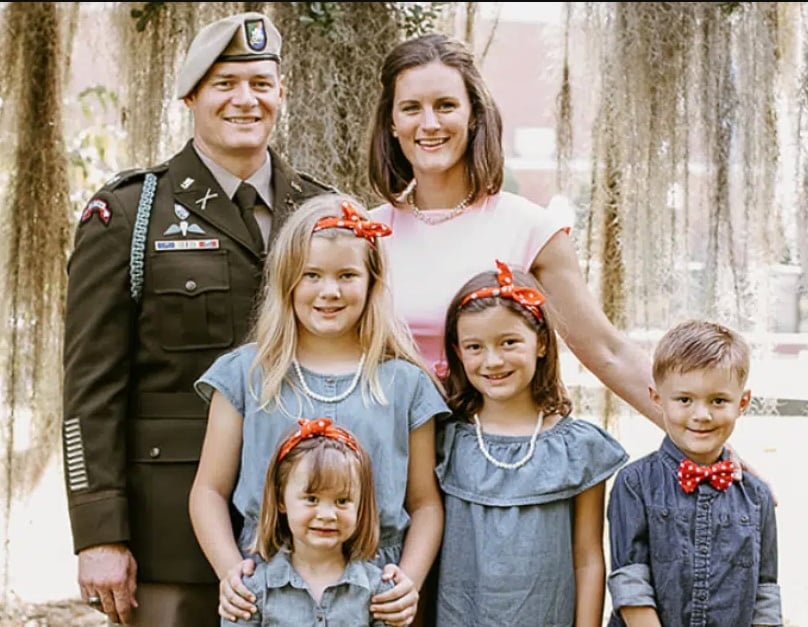
Kelvington initially pleaded not guilty to the charges. His decision to enter a plea agreement marks a decisive turn in a case that has drawn intense scrutiny — not only for the nature of the allegations, but for the broader questions it raises about due process, command influence, and the Army’s handling of senior officers accused of misconduct.
A Career Spanning War, Academia, and Special Operations
Kelvington’s military résumé is extensive. Commissioned after the September 11 attacks, he served multiple combat tours in Iraq and Afghanistan, including assignments with the 82nd Airborne Division, Joint Special Operations Command, and the 75th Ranger Regiment. His career included company command in combat, senior staff positions at the regimental level, and selection as a General Wayne A. Downing Scholar, earning a graduate degree from Princeton University.
By 2021, Kelvington was serving as Professor of Military Science and Leadership at Ohio State, overseeing ROTC training and mentorship — a role that places officers in positions of exceptional authority over cadets’ academic and military futures.
It was during this assignment that the allegations emerged.
Allegations and Investigations
According to investigative findings summarized in records obtained by student journalists and later referenced in military proceedings, Ohio State University’s Office of Institutional Equity concluded there was “sufficient evidence” that Kelvington engaged in a prohibited relationship with an ROTC cadet, along with conduct characterized as sexual misconduct and abuse of authority.
The Army subsequently preferred charges that included sexual harassment, conduct unbecoming an officer, abuse of a training leadership position, and related offenses under the Uniform Code of Military Justice. The Army Special Trial Counsel confirmed that Kelvington ultimately agreed to plead guilty to some or all specifications under a negotiated deal, contingent on judicial approval.
If the military judge rejects the plea, the case could still proceed to a contested court-martial.
Kelvington and his defense counsel did not provide public comment prior to reporting on the plea agreement.
A Wife’s Public Rebuttal: “This Was Never About Truth”
While the court process moved forward, Kelvington’s wife, Meg Kelvington, an Army veteran and former military aviator, launched a public campaign asserting that her husband was falsely accused and denied basic due process.
In a lengthy essay published online in June 2025, she accused Army Cadet Command leadership and investigators of relying on coerced testimony, ignoring exculpatory evidence, and allowing political and institutional pressures to override fairness. She alleged that an initial sworn statement by the cadet denied any wrongdoing, but later changed under pressure — a claim not publicly substantiated in court records.
Meg Kelvington further alleged that investigators failed to conduct an independent criminal inquiry, relied heavily on campus-level findings, and improperly revisited investigative conclusions to justify command decisions already made. She described the Article 32 preliminary hearings as procedurally flawed and accused senior leaders of prioritizing institutional protection over truth.
“These charges were decided before the investigation was complete,” she wrote, arguing that the Army weaponized sexual misconduct prevention programs to destroy her husband’s career rather than seek facts.
Medical Issues and Delays
Complicating the legal proceedings were Kelvington’s documented medical conditions. According to his wife, he underwent major surgeries, including spinal fusion and shoulder replacement, while the case remained unresolved. She alleged that requests for reasonable delays were denied and that administrative actions continued while he was on convalescent leave.
Court records confirm prolonged pretrial timelines, though the Army has not publicly addressed claims regarding medical accommodations or alleged violations of speedy trial requirements.
Why Plead Guilty?
The plea agreement raises an unavoidable question: why would a senior officer, supported by a family asserting total innocence, agree to plead guilty?
Military law experts note that plea agreements in court-martial proceedings can be driven by practical realities rather than admissions of factual guilt. These include:
- Avoiding maximum sentencing exposure
- Preserving limited retirement or medical benefits
- Ending prolonged legal uncertainty
- Protecting family stability
The terms of Kelvington’s plea have not yet been publicly released, leaving open questions about sentencing limitations, retirement eligibility, and discharge characterization.
A Case With Broader Implications
Regardless of how the court ultimately rules, the Kelvington case highlights a widening fault line inside the modern military justice system — one where commanders face immense pressure to act swiftly on allegations, while accused service members increasingly argue that procedural safeguards are eroding.
For some, the plea validates the investigative process. For others, it underscores the leverage the system holds over accused officers whose careers, health care, and pensions hang in the balance.
Meg Kelvington has called for congressional intervention, urging lawmakers to examine what she describes as a “politicized and broken” system that sacrifices individuals to preserve institutional narratives.
“This is bigger than us,” she wrote. “If a decorated combat veteran can be destroyed this easily, what protection does anyone really have?”
A military judge is expected to review Kelvington’s plea agreement in February. If accepted, sentencing proceedings will follow. If rejected, the case could return to a fully contested court-martial.
The Army has not announced whether any administrative or leadership reviews are underway concerning the handling of the investigation itself.
The Salty Soldier will continue to monitor the proceedings and seek official comment from Army Cadet Command, the Office of the Judge Advocate General, and the Army Special Trial Counsel.
The Salty Soldier has submitted multiple Freedom of Information Act requests to the U.S. Army seeking records related to investigative handling, charging decisions, criminal investigative involvement, coordination with Ohio State University, and the consideration of medical accommodations in Lt. Col. Michael Kelvington’s case. The Army has not yet released those records.
© 2026 The Salty Soldier. All rights reserved.